UAE Electronic Invoicing Guidelines: How to Prepare Your Business
Dubai sells itself. One time zone bridges the European morning and the Asian afternoon, and a short flight reaches Europe, Africa and South Asia. Companies set ...
The UAE just changed how invoices work. E-invoicing in UAE is no longer a future project. It is a legal standard for B2B and B2G transactions. The UAE Ministry of Finance (MoF) is replacing unstructured invoice formats with a mandatory structured digital framework. A regular PDF process will not satisfy the new standard.
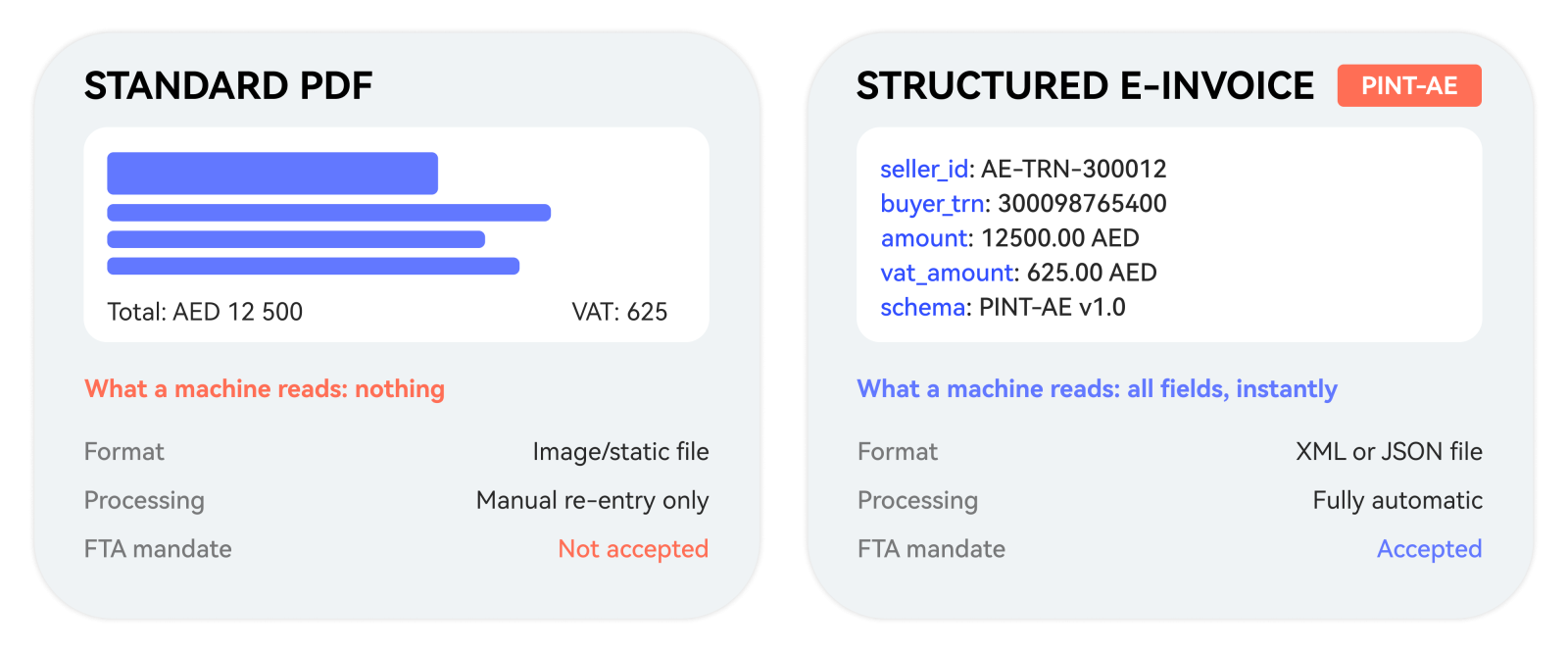
What it is: UAE e-invoicing is now law. PDFs and printed invoices no longer meet the standard. The mandate requires a structured data file (XML/JSON in PINT-AE format).
Who it affects: B2B and B2G transactions; B2C is currently excluded.
How it works: Invoices are exchanged system-to-system via an Accredited Service Provider (ASP) using a 5-corner model.
An e-invoice in the UAE is a structured data file in PINT-AE format that travels system-to-system through a Ministry of Finance-certified ASP. It is not a PDF, a Word document, or a scanned image. The UAE framework governing this exchange is called the Decentralized Continuous Transaction Control and Exchange (DCTCE) architecture.
A PDF invoice is like a screenshot of a spreadsheet. You can read every number, but no system can sort, filter, or calculate from it. A structured XML e-invoice is the actual file. Your client's software opens it and processes every field without a human touching it.
Are you ready for UAE E-Invoicing?
UAE e-invoicing applies to B2B (business-to-business) and B2G (business-to-government) transactions. B2C sales are currently excluded.
E-Invoicing Readiness Check
Ask yourself these three questions:
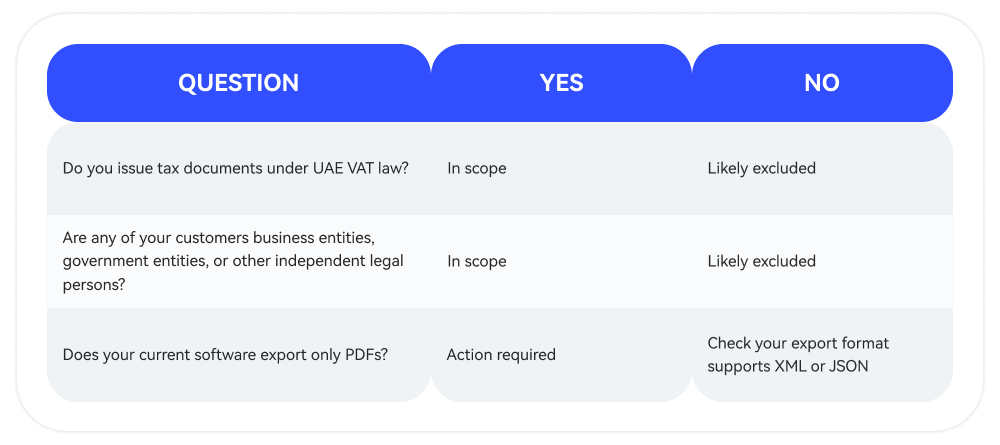 Three "Yes" answers put you directly in scope. Now consider this scenario. An SME trading company in Dubai runs legacy accounting software that exports PDFs only. Once a large corporate client falls under the mandate, that client must receive structured electronic invoices exclusively.
The impact runs in both directions. Suppliers who can't issue structured invoices get filtered out by enterprise procurement systems and government tenders automatically.
On the buyer side, AP teams that currently key invoice data manually will see that workload eliminated, but only if their own software is integrated and their suppliers are compliant.
There is also a cost event before any of this goes live: selecting an ASP, integrating it with the accounting system, and testing before the phase deadline. That is not a day-one expense, but it is a real one, and businesses that treat it as a last-minute IT task typically miss their go-live window.
Yes, but in phases. UAE e-invoicing is being introduced in phases. Affected businesses are required to follow the applicable timeline. Phase 1, targeting businesses with annual revenues at or above AED 50 million, is scheduled to begin in January 2027. The earlier waves apply to larger thresholds.
To find out exactly when your business needs to appoint an ASP and go live, view our breakdown of the UAE e-invoicing timelines.
How does the UAE 5-Corner Model work?
The UAE 5-corner model is the operational framework of the DCTCE architecture. In this model, a structured invoice passes through five distinct parties before the transaction is considered compliant: the supplier, two ASPs, the buyer, and the FTA.
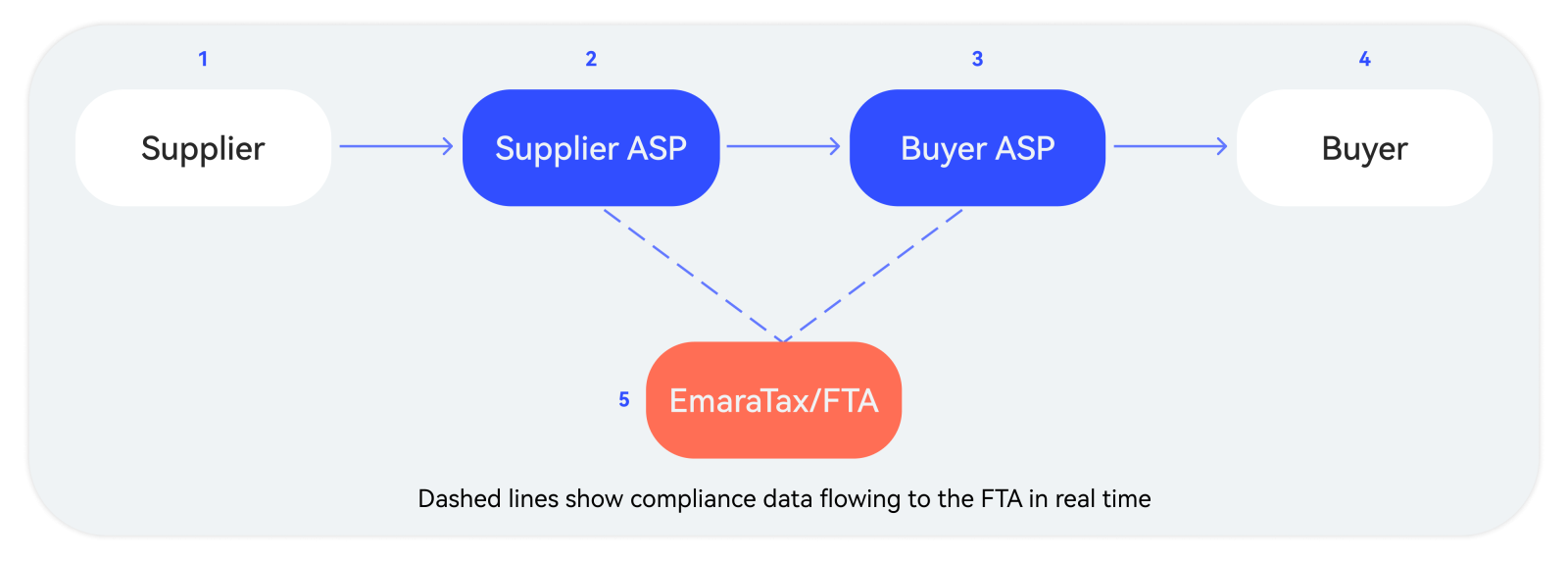
Think of an ASP like a mobile network provider. You write a text message; your network transmits it to your client's network, which delivers it to their phone. The government acts like the telecom regulator, receiving a delivery receipt for compliance without interrupting the message.
The Ministry of Finance requires all structured invoice data to pass through a certified platform before reaching the buyer. This is your ASP.
An Accredited Service Provider UAE businesses must use is an MoF-certified technology intermediary that connects your accounting system to the Peppol network. You cannot transmit compliant invoices directly. It is not optional.
A compliant structured electronic invoice UAE businesses issue must contain the following:
seller identity
buyer identity
transaction details
VAT data
All should be formatted to the PINT-AE schema. No field is optional once the mandate applies to your business.
Start by auditing your current software. Can it generate XML or JSON output in PINT-AE format? If not, that gap needs closing before the phase deadline.
Select a certified Accredited Service Provider early and test your system integration in advance. Missing your go-live date or failing to report outages to the FTA can result in administrative fines. The penalties are avoidable. Our UAE e-invoicing penalties page explains what the FTA enforces and when.
Do businesses in UAE free zones need to comply with e-invoicing?
Yes, if your free zone business is registered for UAE VAT and issues tax invoices. The mandate follows business licensing authority, not VAT registration status or physical location.
Does e-invoicing replace your VAT return submission to the FTA?
No. E-invoicing and the VAT return are separate obligations. The DCTCE framework transmits transaction-level data to EmaraTax in real time. The periodic VAT return filing through EmaraTax remains a distinct legal requirement. Both obligations run in parallel once the mandate applies to your business.
What happens if your ASP has a technical outage?
The ASP is required to notify the FTA of any system disruption within a defined window. As the business issuing the invoice, you are expected to have a contingency process in place and to document the outage. Failing to report or sending non-compliant invoices during an outage can trigger FTA administrative review.
Dubai sells itself. One time zone bridges the European morning and the Asian afternoon, and a short flight reaches Europe, Africa and South Asia. Companies set ...
The UAE e-invoicing requirements are not a future concept anymore. The first wave of businesses faces a hard go-live date of January 1, 2027.
UAE e-invoicing penalties are confirmed, codified, and already in force. The UAE Electronic Invoicing System (EIS) requires businesses to issue, transmit, and r...
The UAE e-invoicing timelines are determined. A mandatory phased schedule is upon VAT-registered businesses now. Missing a deadline means penalties start immedi...
Download the app and make your everyday
life more efficient*
* coming in late 2026