UAE Electronic Invoicing Guidelines: How to Prepare Your Business
Dubai sells itself. One time zone bridges the European morning and the Asian afternoon, and a short flight reaches Europe, Africa and South Asia. Companies set ...
Today, many UAE small businesses still issue invoices the same way: a PDF by email, a manual VAT entry, and a follow-up call when payment is late. The benefits of e-invoicing start exactly where that process breaks down. A mismatched field or a missing VAT registration number pushes a payment into the next cycle. Meanwhile, your records and the FTA's are already out of sync. The UAE Electronic Invoicing System (EIS) catches those errors at transmission, before they reach your buyer or your VAT return.
Five benefits of e-invoicing UAE businesses see first
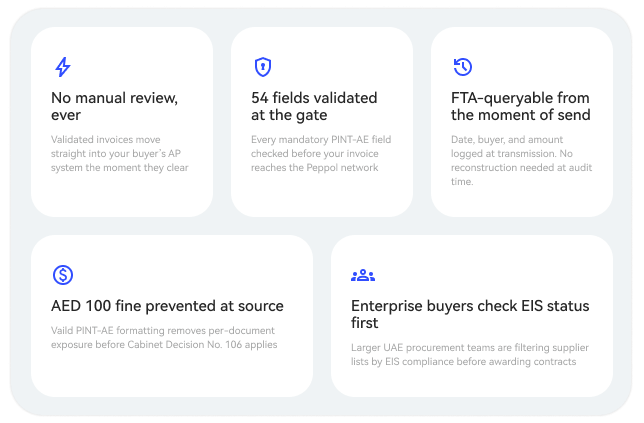
B2B payment delays in the UAE usually start with a disputed invoice. Under the EIS, disputes are caught at the point of transmission through the Peppol network. Pass, and your buyer's AP system picks it up automatically. Fail, and it bounces before any human touches it.
The FTA cross-references your VAT submissions against your invoice records. One mismatched field is enough to open a review. Mismatches result in queries. Queries become audits.
The EIS mandate requires 54 mandatory data fields under the PINT-AE standard. Your software validates every one of them before transmission. A wrong or missing field gets rejected at transmission. Not flagged six months later when your VAT return is under review.
Ensure your system meets the official UAE e-invoicing requirements before your go-live date to prevent automatic document rejection.
Every invoice transmitted through the EIS is logged, timestamped, and stored in a format the FTA can query directly. For a small business, it is an automatic audit trail. No manual filing. No reconstructing records from email chains.
When your VAT return period closes, your e-invoicing record and your FTA submission align by design. When the FTA queries your records, there is nothing to reconstruct.
AED 100 per invalid document. Up to AED 5,000 per month for failing to appoint an accredited Access Point (ASP).
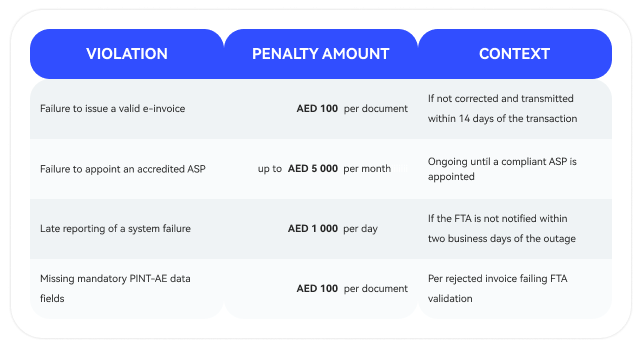
One invoice error. Two separate fines. Finance teams call this tax penalty stacking.
In the UAE, a failed e-invoice generally produces a VAT reporting gap (a second, separate FTA fine under standard misreporting rules). There are two penalties in parallel. Take a business running 200 B2B invoices a month ahead of the January 2027 Phase 1 deadline. One system gap creates two separate penalties running at the same time. The cost stacks fast.
No invalid invoice, no stacked fines. The first error is the only one worth preventing.
Procurement teams at larger UAE companies are building preferred supplier lists around EIS compliance. If your invoice cannot enter their Peppol-connected AP system, it creates manual work on their side. Some will route around you entirely.
Full compliance before your mandate date means you are ready when those buyers run their checks. That is a commercial edge that has nothing to do with fines.
Businesses that adopt the EIS before their mandatory phase face zero e-invoicing penalties during the testing period. That time can be used to find gaps in your data fields and fix integration issues before enforcement begins. For businesses with intra-group transactions inside a VAT group, the February 2026 FTA guidelines confirmed fines do not apply for 24 months.
Fewer payment disputes and faster VAT reconciliation. The cash benefit shows up in the payment cycle, not your compliance report.
Yes. The testing period carries zero e-invoicing penalties. During this period, taxpayers can fix integration gaps, validate data fields, and train their team before the enforcement.
A PDF is a file. A UAE e-invoice is structured data routed through an accredited Access Point via the Peppol network to the FTA for real-time validation. A PDF sent by email has no standing under the EIS.
Phase 1 covers B2B and B2G transactions only. B2C invoices are currently outside the mandate. Check your transaction mix against the FTA phase schedule to confirm your scope.
By the time your VAT return period closes, every transmitted invoice is already logged in the FTA system. There is no manual reconciliation step. Your return reflects records the FTA has held since transmission.
Dubai sells itself. One time zone bridges the European morning and the Asian afternoon, and a short flight reaches Europe, Africa and South Asia. Companies set ...
The UAE e-invoicing requirements are not a future concept anymore. The first wave of businesses faces a hard go-live date of January 1, 2027.
UAE e-invoicing penalties are confirmed, codified, and already in force. The UAE Electronic Invoicing System (EIS) requires businesses to issue, transmit, and r...
The UAE e-invoicing timelines are determined. A mandatory phased schedule is upon VAT-registered businesses now. Missing a deadline means penalties start immedi...
Download the app and make your everyday
life more efficient*
* coming in late 2026