Peppol E-Invoicing in UAE: 5 Corner Model Explained
Peppol e-invoicing UAE ends the PDF invoice’s role as the legal record. What takes its place? Structured XML data, moving system-to-system across a national net...
The UAE e-invoicing timelines are determined. A mandatory phased schedule is upon VAT-registered businesses now. Missing a deadline means penalties start immediately.
Two ministerial decisions govern the timelines and the framework:
Both are already in force.
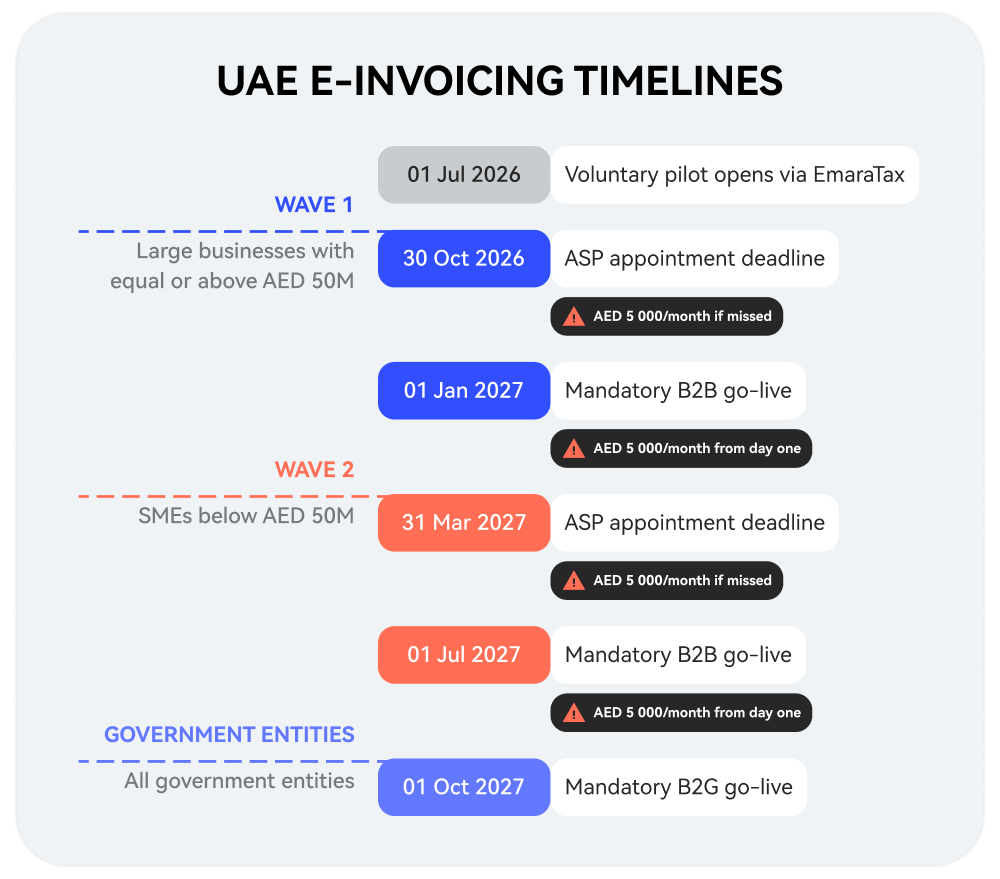
Under Ministerial Decision No. 244, businesses at or above the AED 50 million threshold must appoint an ASP by October 30, 2026. Just 2 months before go-live. Do not miss this.
Your invoicing system must connect to the UAE Electronic Invoicing System (EIS). It is the government's centralised e-invoice processing infrastructure. In the system, PINT-AE is the UAE's adaptation of the international Peppol invoice standard. Invoices that do not conform to PINT-AE formatting will not be accepted by the EIS, regardless of when they are submitted. FTA accredited service providers handle this technical connection on your behalf. They are the only approved route to connect your invoicing system to the EIS.
If your revenue is below AED 50 million, your ASP appointment deadline is March 31, 2027. Mandatory B2B e-invoicing begins July 1, 2027. Your invoicing system must connect to the EIS via a certified ASP before that date. The same PINT-AE data standard applies.
B2G (Government Entities): Businesses transacting with UAE government entities face a separate go-live date of October 1, 2027. This applies regardless of your Phase 1 or Phase 2 classification.
Think of your mandatory go-live date as a driving test. You would not start learning to drive on exam day. The months between now and 2027 are your practice window. For Phase 1 businesses, that window is already closing.
Here is a realistic preparation timeline:
Right now: Confirm whether your invoicing system can produce structured digital data. A PDF export does not qualify.
July 1, 2026: The voluntary pilot opens via EmaraTax. Join early to surface integration issues before your go-live date.
Before your ASP deadline: Appoint your accredited service provider and run a live transaction through the system.
The specific data fields your system needs to support are a topic of their own. Our UAE e-invoicing requirements page covers the mandatory fields in plain terms.
Appointing an ASP is a regulatory obligation. It has its own deadline, separate from go-live. These are two distinct deadlines. Missing the first one does not buy you more time on the second.
Take a UAE trading company sitting at AED 45 million in taxable supplies, squarely in Phase 2. July 1, 2027 is their mandatory go-live. They start the voluntary pilot in July 2026, twelve months early. By March 2027 their ASP connection is tested and operational. When go-live arrives, there is nothing left to scramble for. No penalties. No gaps.
The ASP deadline is not a soft target. It is a separate regulatory obligation with its own penalty clock.
FAQs about UAE e-invoicing timeline
What is UAE e-invoicing?
It is a mandatory government framework rolled out across UAE e-invoicing phases. VAT-registered businesses must issue and report structured digital invoices through the Federal Tax Authority's EIS. Commonly used PDF invoices and traditional paper-based processes no longer qualify.
What is the penalty for missing the UAE e-invoicing deadline?
Cabinet Decision No. 106 of 2025 declares the penalty at AED 5,000 per month. Additional penalties that apply per electronic invoice and per electronic credit note which are not issued or transmitted. The clock starts on the mandatory go-live date. In case of missing the ASP appointment deadline, a second AED 5,000 per month penalty runs in parallel. The two penalties are independent of each other. For more details about penalties, you can visit our UAE e-invoicing penalties page.
Does the voluntary pilot impact your mandatory go-live date?
No, joining the pilot does not change your Phase 1 or Phase 2 go-live date. It is a preparation window, not an early compliance credit. The mandatory deadline remains fixed.
What if your business crosses the AED 50 million threshold after the reference date?
The phase is determined by taxable supplies in the financial year ending on or before the reference date, not your current figures. Crossing the threshold after that point does not move you into Phase 1 retroactively.
Peppol e-invoicing UAE ends the PDF invoice’s role as the legal record. What takes its place? Structured XML data, moving system-to-system across a national net...
Somewhere between your ERP and the Federal Tax Authority now sits a company you have probably never heard of, and the law says you must hire one. So, what is AS...
Dubai sells itself. One time zone bridges the European morning and the Asian afternoon, and a short flight reaches Europe, Africa and South Asia. Companies set ...
The UAE e-invoicing requirements are not a future concept anymore. The first wave of businesses faces a hard go-live date of January 1, 2027.
Download the app and make your everyday
life more efficient*
* coming in late 2026