UAE Electronic Invoicing Guidelines: How to Prepare Your Business
Dubai sells itself. One time zone bridges the European morning and the Asian afternoon, and a short flight reaches Europe, Africa and South Asia. Companies set ...
The UAE e-invoicing requirements are not a future concept anymore. The first wave of businesses faces a hard go-live date of January 1, 2027.
The UAE e-invoicing requirements are not a future concept anymore. The first wave of businesses faces a hard go-live date of January 1, 2027.
PDF tax invoices no longer qualify with the new system. Businesses and active sole proprietorships must issue structured XML files instead. These e-invoices follow the PINT-AE standard and travel through an accredited intermediary network built on the Peppol framework.
The software is the easy part. Your ERP data is not.
The UAE Electronic Invoicing System (EIS) has a specific technical shape. VAT-registered businesses must generate B2B and B2G invoices as machine-readable XML files in PINT-AE format. Every one of them goes through a government-accredited service provider before it reaches the buyer. The requirement is XML. Particularly:
not scanned PDFs
not Word documents
not spreadsheets exported to PDF
The governing format is PINT-AE, the UAE's localized profile built on the international Peppol Invoice Network standard.
This architecture is called the Decentralized Continuous Transaction Control and Exchange (DCTCE) model. Your software must ping an accredited provider before the invoice reaches the buyer. It happens in seconds. But it requires strict formatting compliance at every field level.
The MoF and FTA share joint authority over the EIS. Together, they published detailed guidelines in February 2026. They require Invoice Transaction Type Codes baked directly into every XML file: hard-coded flags that tell the system whether it is looking at a Free Zone supply, a Margin Scheme transaction or a Continuous Supply contract.
The EIS mandate impacts VAT-registered businesses operating taxable B2B and B2G transactions in the UAE. It does not currently contain B2C retail transactions.
Many UAE businesses are expected to fall within the phased rollout, depending on official scope and timing. The primary factor for the first wave is annual revenue.
Which businesses are likely to be in scope first?
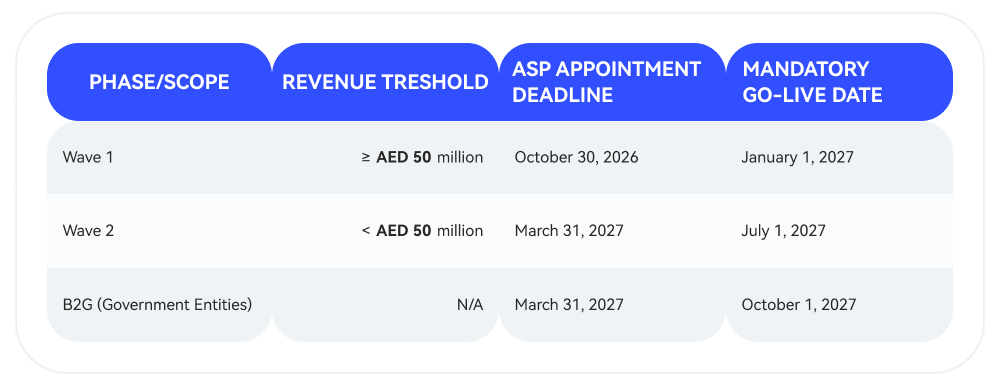
Wave 1 targets entities with annual revenue at or above AED 50 million. This covers large corporates, major distributors, and significant service providers, businesses whose transaction volumes create the highest risk of a tax gap without real-time reporting.
Are SMEs affected or only large enterprises?
SMEs are not exempt; they are simply given more time.
Wave 2 covers businesses below the AED 50 million threshold, with a mandatory go-live date of July 1, 2027. If your revenue is below, there is room to prepare. But not room to ignore it.
Does VAT registration automatically mean immediate e-invoicing obligations?
VAT registration does not automatically generate an immediate EIS obligation. The phasing is based on revenue thresholds and business type, not VAT registration status alone.
The February 2026 guidelines have one major piece of information worth recognizing. Intra-VAT-group transactions are granted a 24-month grace period before full EIS obligations kick in. It presents group entities more time to align their internal invoicing infrastructure.
The UAE e-invoicing timeline 2026 starts the go-live date on January 1, 2027 for Wave 1. But the ASP appointment deadline is October 30, 2026.
Missing that means being non-compliant before you have issued a single e-invoice.
 What to verify in the official rollout calendar
The revenue band should be confirmed against the MoF's official threshold definitions. Revenue calculations for the EIS threshold follow specific accounting rules. Confirm with your tax adviser before assuming you fall into Wave 2.
Wave 1 vs later phases
Wave 1 businesses have the tightest window. From the July 2026 ASP appointment through EmaraTax onboarding to technical go-live in January 2027. That is roughly 6 months of integration, testing, and staff training.
What to do 6–12 months before the expected onboarding
Start with your data audit. Not your software vendor shortlist.
Every buyer and supplier in your ERP will need a validated Tax Registration Number (TRN). Many systems have gaps, duplicates, or outdated entries. That is the real bottleneck, and no ASP can fix it for you.
A PDF invoice is like a photograph of a spreadsheet. A human can read it, but a computer cannot calculate it without manual data entry.
An XML file in PINT-AE format is the actual underlying data spreadsheet, with every single row, tax code, and buyer ID perfectly labeled, so the government's systems are able to validate it instantly without human involvement.
Required invoice fields to validate
The February 2026 guidelines specify mandatory XML fields beyond standard VAT invoice requirements. These include:
Invoice Transaction Type Code
Buyer & seller TRN
Supply type classification: standard-rated, zero-rated, exempt, Free Zone
Line-level tax amounts
Unique invoice identifier formatted to PINT-AE schema rules
Structured data and interoperability requirements
Peppol PINT-AE interoperability means your ASP must be able to communicate with any other Peppol-registered ASP in the UAE network.
If your buyer uses a distinct ASP, the system still routes the invoice automatically. That is exactly how Peppol was designed, but it only works if the XML output is schema-valid from the start.
Record retention, audit trail, and integration readiness
Invoices must be retained in their original XML format for the duration required by UAE tax law. PDF visual copies are permissible as supplementary documents. But the XML file is the legal instrument. Archive accordingly.
Yes to the first. Maybe to the second.
Every Wave 1 business needs to appoint an accredited service provider in the UAE by October 30, 2026. That is not optional, and failure to appoint within the prescribed timeline is treated as a violation subject to administrative penalties under Cabinet Decision No. 106 of 2025.
In the UAE Peppol-based model, you send your invoice data to your accredited service provider. The ASP validates the XML file and routes it to the buyer's accredited service provider and to the FTA, before the buyer ever opens the invoice.
The ASP sits between your invoicing system and the network. Choose one that has confirmed FTA accreditation, a clear SLA for uptime and invoice validation, and a documented integration path for your ERP.
Systems that can integrate with an Accredited Service Provider and support the transmission of structured electronic invoice data are closer to what the UAE e-invoicing framework requires. That matters when you are evaluating technical fit.
On the software question: if your current platform cannot output PINT-AE-compliant XML, or cannot connect to an ASP via API, then yes. You need an upgrade or an integration layer. If it can, your priority is data quality, not a platform switch.
Software selection for EIS compliance is a technical decision, not just a procurement one. The wrong criteria lead to expensive integrations that still fail at data validation.
Questions to ask an e-invoicing vendor
Can your system generate PINT-AE-compliant XML natively, or does it rely on a third-party transformation layer? What is your validation process for mandatory Invoice Transaction Type Codes? How do you handle schema updates when the MoF revises PINT-AE specifications?
Questions to ask an ASP or implementation partner
Are you listed on the FTA's official accredited service provider UAE registry? What is your process for handling rejection errors returned by the DCTCE network? Do you provide structured error logs that map back to specific XML field failures?
What Billingo should and should not claim
Billingo is designed to support UAE e-invoicing readiness, not to replace the tax advice or ASP selection process you need.
Its API-first architecture supports automating invoice generation via API, which helps teams maintain more consistent invoicing records and workflows as requirements evolve.
It can help generate invoice data in the format your implementation requires. Software alone does not make a company legally compliant; a qualified UAE tax professional and an FTA-accredited ASP are required.
Treating it as an IT project, not a data project. The technology is solvable. Dirty master data is what delays go-live
Confusing the ASP appointment deadline with the go-live date. October 30, 2026 and January 1, 2027 are 2 separate, independent deadlines for Wave 1
Assuming Free Zone entities are exempt. They are not. Free Zone supplies require specific PINT-AE transaction type coding, not exclusion from the system.
Selecting an ASP on price alone. Uptime SLAs, error handling workflows, and ERP integration depth matter far more than licensing cost
Ignoring the UAE e-invoicing penalties until after a filing error. Under Cabinet Decision No. 106 of 2025, the fines are per-month and per-invoice; they accumulate
Is e-invoicing mandatory in the UAE?
Yes. It is rolled out in different waves. By January 1, 2027, wave 1 businesses with revenue at or above AED 50 million must be live. Wave 2 and B2G entities have a mandatory go-live of July 1 and October 1, 2027 respectively.
Are there UAE e-invoicing penalties?
The Cabinet Decision No. 106 of 2025 establishes the penalties for UAE e-invoicing non-compliance:
Failing to appoint an ASP on time carries a fine of AED 5,000 per month.
Each invalid electronic invoice issued outside the mandated format adds AED 100 per document.
Is it still possible to send PDF invoices to your customers?
A standard PDF will no longer function as legally valid documentation on its own. It is possible to send a visual PDF copy alongside the invoice for readability. Yet the legally binding instrument is the PINT-AE XML file transmitted through your ASP.
What are the biggest challenges of UAE e-invoicing implementation?
The hardest part is almost never the XML generation itself. It is the upstream data problem: missing buyer TRNs, incorrect Free Zone tax codes, or inconsistent supply type classifications in ERP master data. No software can fix that automatically.
Dubai sells itself. One time zone bridges the European morning and the Asian afternoon, and a short flight reaches Europe, Africa and South Asia. Companies set ...
UAE e-invoicing penalties are confirmed, codified, and already in force. The UAE Electronic Invoicing System (EIS) requires businesses to issue, transmit, and r...
The UAE e-invoicing timelines are determined. A mandatory phased schedule is upon VAT-registered businesses now. Missing a deadline means penalties start immedi...
Today, many UAE small businesses still issue invoices the same way: a PDF by email, a manual VAT entry, and a follow-up call when payment is late. The benefits ...
Download the app and make your everyday
life more efficient*
* coming in late 2026