UAE Electronic Invoicing Guidelines: How to Prepare Your Business
Dubai sells itself. One time zone bridges the European morning and the Asian afternoon, and a short flight reaches Europe, Africa and South Asia. Companies set ...
UAE e-invoicing penalties are confirmed, codified, and already in force. The UAE Electronic Invoicing System (EIS) requires businesses to issue, transmit, and receive invoices in a structured electronic format through a licensed Accredited Service Provider (ASP) connected to the Peppol network.
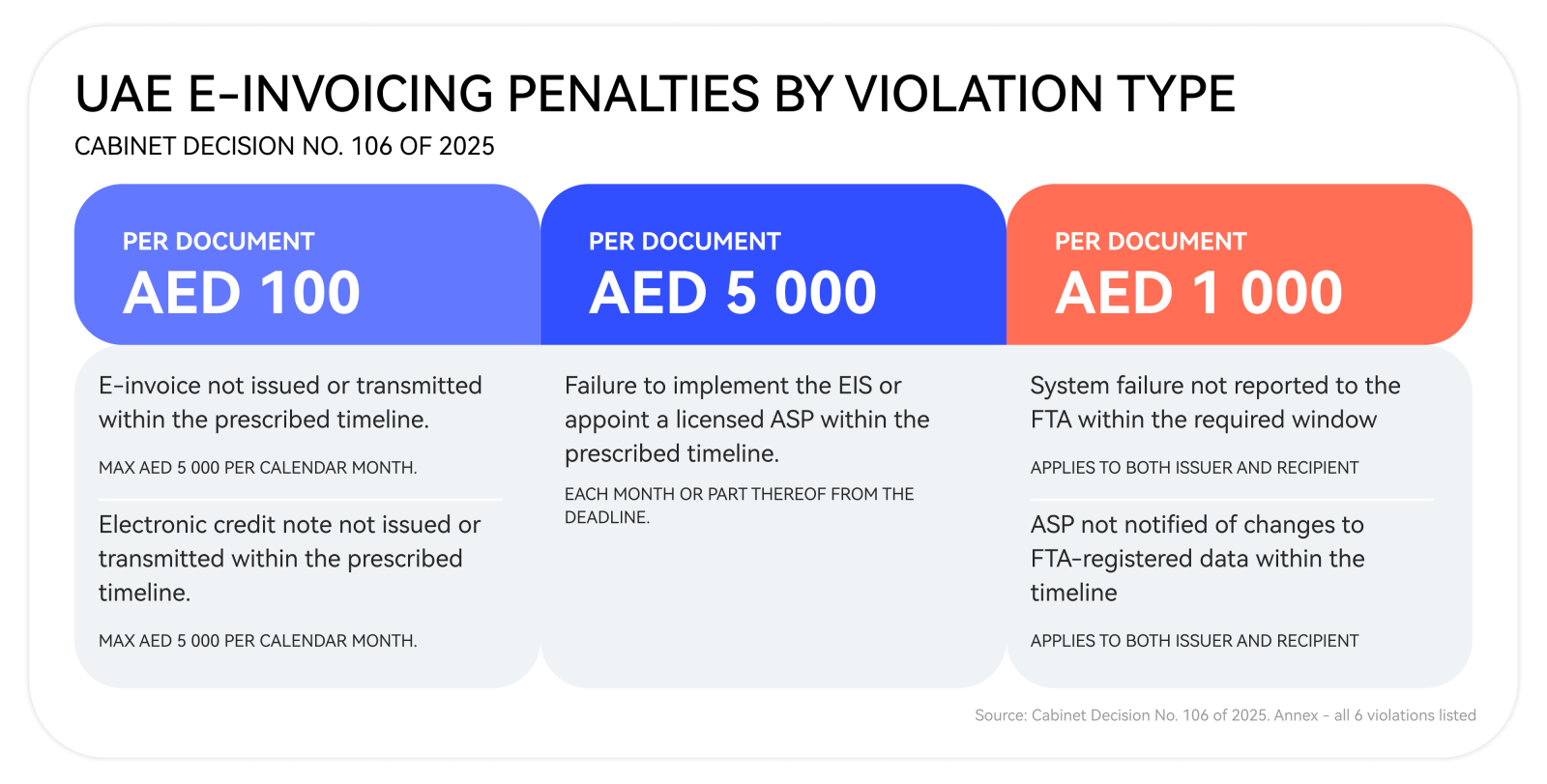
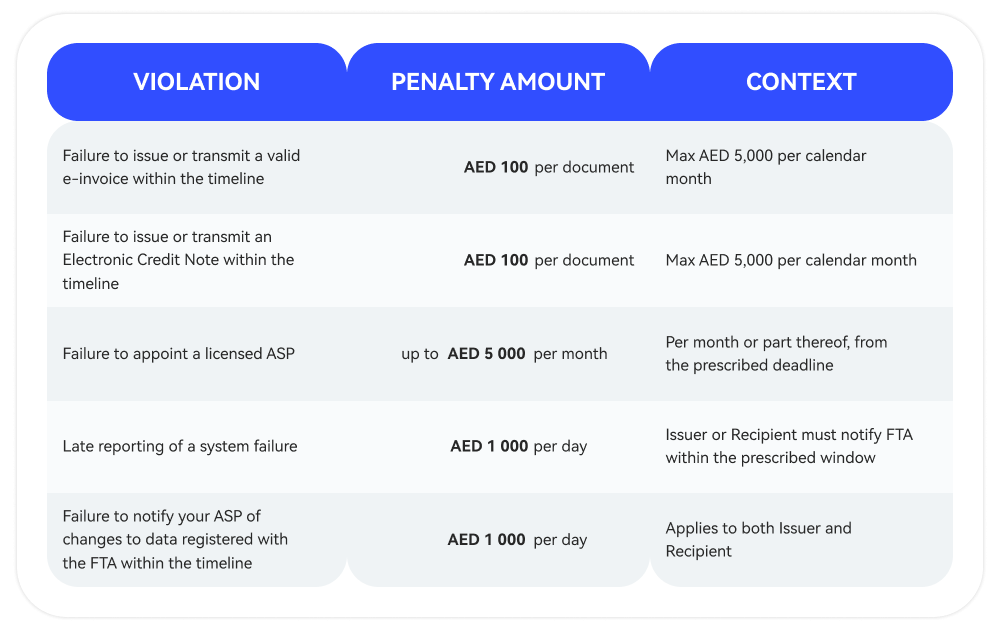
Cabinet Decision No. 106 of 2025 defines every fine in this article. The risk depends entirely on the mandate tier. Businesses that join the EIS before their mandatory deadline, voluntarily, face no e-invoicing penalties during the testing period. That protection ends on the mandate date. Not a day later.
Check your exact compliance deadline on our complete UAE e-invoicing timelines page.
The exposure comes down to two variables: your business tier and your invoice volume. Phase 1 targets large taxpayers from January 2027. Phase 2 follows for smaller businesses.
One clarification from the guidelines: VAT group transactions carry a 24-month grace period. These are invoices between related entities that share a single VAT registration. Punitive measures do not apply during that window.
B2C transactions and exempt financial services currently sit outside the mandate scope. Affected businesses should verify their specific phase with a qualified UAE tax advisor.
The FTA e-invoicing portal UAE connects to your invoicing software through a licensed ASP. That link must hold. Every single time.
For operational purposes, taxable persons can still issue PDF or human-readable invoices. However, your customer cannot claim input VAT without receiving a valid e-invoice through the EIS. That makes non-compliant formats a direct financial liability for the recipient.
Tax Penalty Stacking in the UAE
Tax penalty stacking describes the compounding impact when one invoicing error triggers multiple simultaneous fines. AED 100 per document is the starting point. That same missing invoice might create a VAT reporting discrepancy, generating a separate FTA administrative penalty on top.
The FTA does not use this label in its official penalty framework. The industry does, because the compounding effect is exactly what businesses experience on the ground.
Consider a UAE SME processing 500 B2B invoices monthly as the January 2027 Phase 1 deadline approaches. If 5% fail validation due to missing mandatory fields, that is 25 documents at AED 100 each. AED 2,500 in e-invoicing fines alone, before VAT misreporting exposure is calculated. Ensure your system meets the official UAE e-invoicing requirements before your go-live date to prevent automatic document rejection.
Questions businesses ask most about UAE e-invoicing penalties
What is the penalty for an e-invoice in the UAE?
The per-document fine for an invalid or missing e-invoice is AED 100. Operating without a licensed Access Point provider adds up to AED 5,000 monthly on top of that.
Are there e-invoicing penalties during the voluntary phase?
No. Businesses adopting the EIS before their mandatory deadline are exempt from e-invoicing penalties during the testing process. The exemption is not available on your mandatory compliance date.
What happens if an invoice is not issued correctly?
It fails validation in the Peppol network. If you do not rectify and retransmit within the timeline prescribed by the Minister, the AED 100 per-document fine applies automatically.
Dubai sells itself. One time zone bridges the European morning and the Asian afternoon, and a short flight reaches Europe, Africa and South Asia. Companies set ...
The UAE e-invoicing requirements are not a future concept anymore. The first wave of businesses faces a hard go-live date of January 1, 2027.
The UAE e-invoicing timelines are determined. A mandatory phased schedule is upon VAT-registered businesses now. Missing a deadline means penalties start immedi...
Today, many UAE small businesses still issue invoices the same way: a PDF by email, a manual VAT entry, and a follow-up call when payment is late. The benefits ...
Download the app and make your everyday
life more efficient*
* coming in late 2026