Peppol E-Invoicing in UAE: 5 Corner Model Explained
Peppol e-invoicing UAE ends the PDF invoice’s role as the legal record. What takes its place? Structured XML data, moving system-to-system across a national net...
Somewhere between your ERP and the Federal Tax Authority now sits a company you have probably never heard of, and the law says you must hire one. So, what is ASP in e-invoicing terms? A definition, an obligation, and a deadline all wearing the same three letters. Miss the third part and the fines write themselves.
All three answers live in this guide, along with the deadlines, the penalties, and a selection framework you can put in front of your board.
Start with the dates. If your business sits in Wave 1, the contract needs a signature by October 30, 2026. Operate without one after that and the FTA bills you AED 5,000 a month, part months included.
The definition first, then the rest.
An Accredited Service Provider is a private technology firm the UAE Ministry of Finance has vetted under Ministerial Decision No. 64 of 2025 to check, deliver, and report your electronic invoices.
Accreditation here sits closer to a banking licence than a partner logo. Ministerial Decision No. 64 of 2025 demands OpenPeppol certification, ISO-grade security and continuity credentials, insurance cover, a UAE registration, and a tax record without blemishes. The Ministry amended those criteria in May 2026 through Ministerial Resolution No. 56 of 2026, which added a requirement that the provider’s e-invoicing product must have at least two years of live operation behind it.
So what does an ASP for e invoicing actually do all day? Three jobs. It checks every invoice you create against PINT-AE, the UAE’s mandatory data standard that defines which fields an invoice must carry and how the XML must be structured. It carries the validated document across the Peppol network, the international rails the UAE has adopted for exchanging business documents. And it reports a summary of the tax data straight to the Federal Tax Authority.
A comparison helps here. Your invoicing software is the desk where you write a legally binding letter. The ASP is the registered post office: it checks your identity, confirms the envelope meets postal standards, delivers it to the recipient’s post office, and files a stamped delivery receipt with the government. Writing the letter was never the regulated part. Moving it is.
Yes. Under Ministerial Decision No. 243 of 2025, no in-scope invoice may travel outside an accredited provider. You issue through one, you receive through one, and the FTA hears about it through one.
Ministerial Decision No. 243 of 2025 wrote that rule, and notice what it never says: senders only. ASP e invoicing UAE obligations bind the buyer just as tightly, so you need an accredited connection to receive compliant invoices, not just to send them. Peer-to-peer exchange between two ERPs, however sophisticated, does not satisfy the law.
Run yourself through four questions before you spend a dirham on vendors:
Four questions, four answers, and you know exactly where you stand. Once you are in scope, the only open variable is timing, and the next section pins that down.
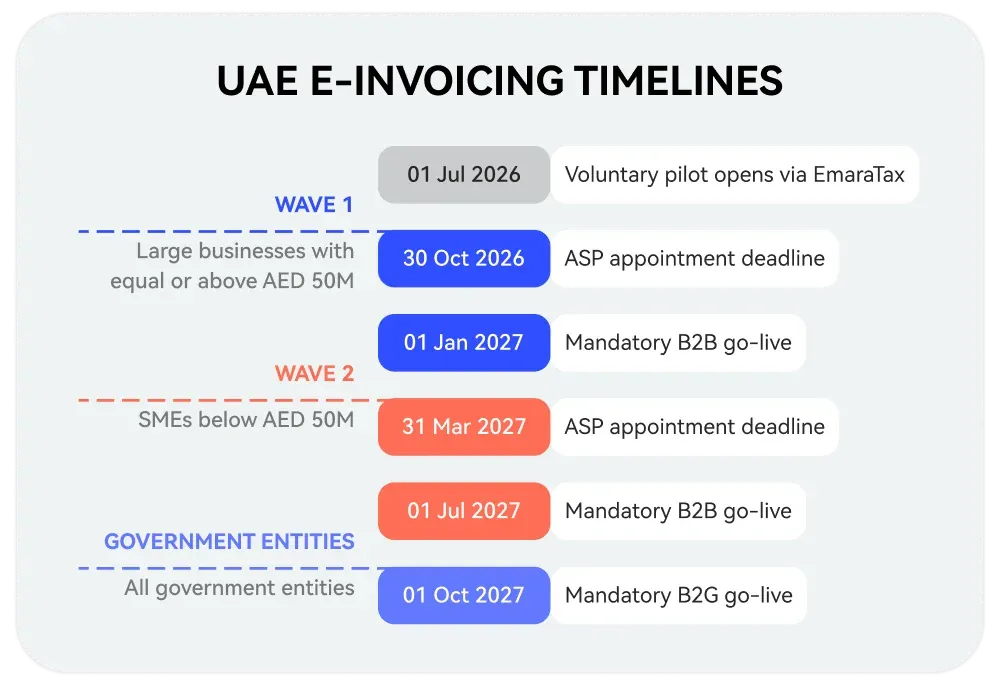
Every ASP e invoicing UAE deadline traces back to Ministerial Decision No. 244 of 2025. Then May 2026 happened. Ministerial Decision No. 66 of 2026 pushed the Wave 1 appointment cut-off back a full quarter, from July 31, 2026 to October 30, 2026. Older articles still quote the July date. Ignore them.
At or above AED 50 million in annual revenue, you are Wave 1, and two dates now run your year: a signed ASP agreement by October 30, 2026, then live exchange from January 1, 2027. Look closely at which of those the amendment touched. The signature slipped a quarter; go-live stayed bolted to January. Three extra months to sign a contract, zero extra months to be operational.
Below AED 50 million? Wave 2 gives you until March 31, 2027 to appoint and July 1, 2027 to go live. Government entities work to their own track, appointing by that same March date but switching on later, on October 1, 2027.
Your calendar wants one more entry. A supervised pilot began on July 1, 2026, and voluntary adoption opened to every business at the same moment. Joining early costs nothing in penalty exposure, because fines only apply from your mandatory wave onward.
Inside the UAE e-invoicing 5 corner model, your ASP occupies Corner 2 or Corner 3, validating each document, exchanging it with the other party’s provider, and reporting tax data to Corner 5.
The architecture behaves like an international SWIFT wire transfer. Your ERP is the internal ledger recording that money moved, but no bank wires funds abroad from a spreadsheet. The payment travels through verified network nodes that authenticate both ends and log the transaction centrally. Your ASP is that node.
Here is the journey of a single invoice. You generate the data in your own system at Corner 1, your ASP at Corner 2 validates the XML against PINT-AE and hands it to your buyer’s ASP at Corner 3, which delivers it into the buyer’s software at Corner 4. Validation takes seconds.
Corner 5 is what makes the UAE model distinctive. While your invoice travels to the buyer, the ASP sends a Tax Data Document to the FTA’s central platform at the same moment. Nothing waits for the government. Delivery to your customer is never held hostage to the reporting leg, which is precisely why the design is called an exchange-first model.
Your ERP or invoicing software creates and stores invoice data; the ASP converts it to PINT-AE XML, transmits it over Peppol, and reports it to the FTA. Direct ERP-to-FTA reporting is not permitted.
People searching “ASP vs ERP UAE” suspect the two compete. They do not. They stack. The ERP is the system of record where quantities, prices, customer details, and VAT treatments are born. The ASP is the regulated gateway those records must pass through to become legal instruments.
Think of the boundary as a handover of custody. Drafting the invoice, deciding the VAT rate, and keeping the books stay on your side. Format validation, Peppol transmission, delivery confirmation, and FTA reporting sit with the provider. No software licence, however expensive, buys you a direct line to the tax authority, because the law reserves that channel for accredited providers alone.
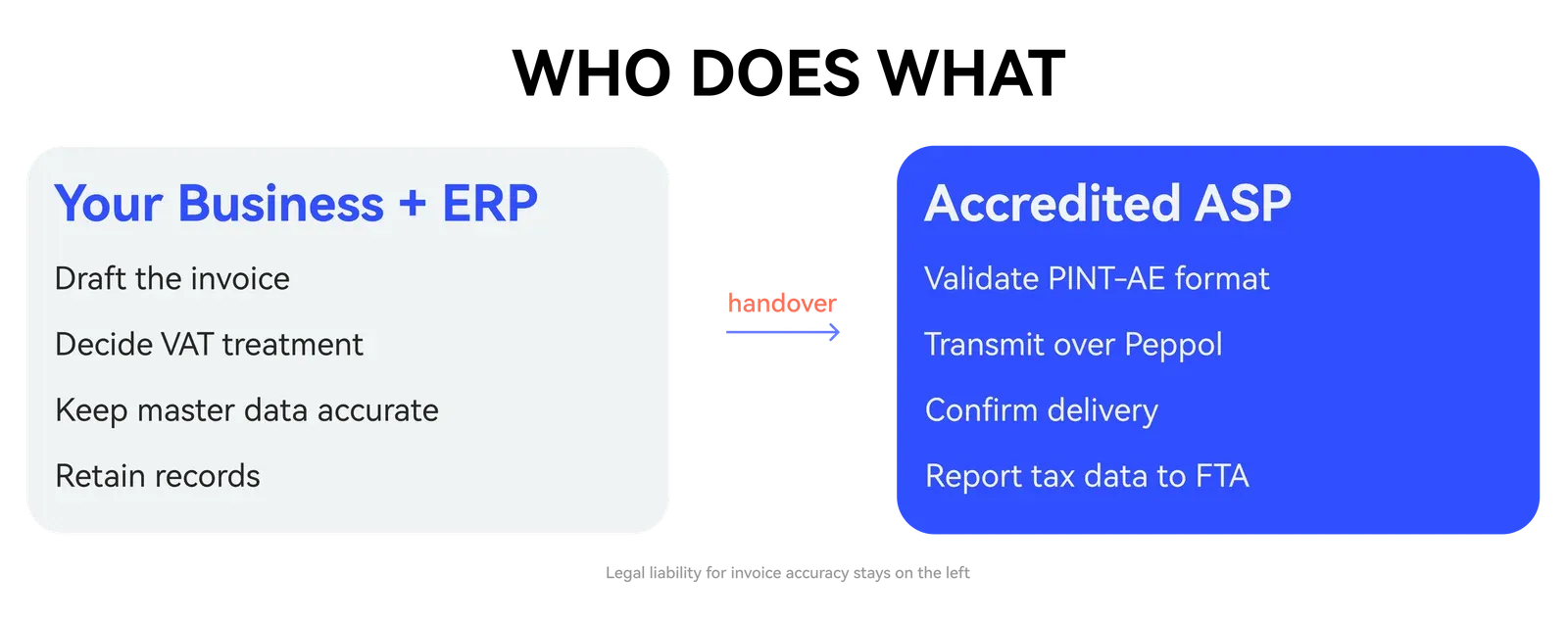
A concrete case makes the split obvious. Picture a Dubai commercial distributor turning over AED 65 million, squarely inside Wave 1. Its ERP keeps drafting invoices exactly as before, yet each one now flows to the appointed ASP, which reshapes the data into PINT-AE XML, fires it across the network, and returns a delivery status before the goods leave the warehouse. The warehouse team sees a green tick, the finance team sees a reported transaction, and the ERP never spoke to the FTA directly.
Beyond legal necessity, an accredited provider gives you instant delivery confirmation, automatic format validation, real-time tax reporting, and interoperability with every other provider on the Peppol network.
Start with the disputes that ASP e invoicing UAE compliance quietly ends. Every exchange generates message-level confirmations, so "we never received your invoice" dies as an excuse, and payment cycles tend to shorten once delivery is provable. Rejections surface within seconds rather than weeks into a payment run.
Validation is the quieter benefit. Your provider intercepts the malformed XML, the absent mandatory field, the total that refuses to add up, all before your buyer or the FTA sees a thing. Every catch is AED 100 the penalty regime never collects. Cheap insurance.
Interoperability closes the list. Peppol obliges every accredited provider to exchange documents with every other one, so you never need to match vendors with your trading partners. Your ASP finds theirs automatically.
Appointing an ASP transfers the technical transmission burden, nothing more. VAT classification, master data accuracy, invoice content, and statutory record retention remain your legal obligations under UAE tax law.
This is where overconfidence gets expensive. Automated validation catches structural formatting errors; it has no opinion on whether you applied the right VAT treatment to a free zone supply or typed the correct TRN for a new customer. Garbage in, compliant-looking garbage out.
The retention duty stays yours as well. Invoice records must be kept in line with UAE record-keeping rules, typically at least five years for VAT purposes and longer where corporate tax applies. Transmission deadlines belong to you too, since in-scope documents must move through the system within the prescribed windows.
One quiet obligation trips people up. If your registered details change, you must notify your appointed provider within the prescribed timeline, and failing to do so costs AED 1,000 per day under the penalty framework. Small task. Real money.
Start with the Ministry of Finance's official register, then compare providers on ERP integration, rejection handling, data residency, pricing structure, and support quality. The register already lists 30-plus names.
Only one list counts, and the Ministry of Finance publishes it, with a queue of vendors behind the published names still finishing the process. Building a genuine MoF approved ASP shortlist takes an afternoon, not a quarter. One nuance worth knowing: providers appear as pre-approved before completing full accreditation, so ask each vendor which stage it has actually reached and request the paperwork.
Choosing an ASP for e invoicing starts at that register rather than ending there, because every name on it clears the same compliance bar. The register tells you who may operate; it says nothing about who fits your business. Dig into the differences with questions like these:
Buried in the accreditation framework sits a clause worth knowing before any pricing negotiation. Under Ministerial Decision No. 64 of 2025, every accredited provider commits to supplying 100 free e-invoice exchange and reporting services per year, counted from the date you sign the end-user agreement.
For a micro-business, that allowance might cover an entire year of compliance at zero transmission cost. Larger firms should treat it as a negotiating card instead. Whichever camp you sit in, get the clause written into the agreement itself, because vendors rarely volunteer it.
Systems fail. The law assumes they will, which is why Cabinet Decision No. 106 of 2025 builds a reporting protocol around downtime rather than pretending it away. When a technical failure stops you from issuing or receiving e-invoices, whether the fault sits in your ERP, your network, or the provider’s platform, you must notify the FTA within two business days.
Miss that window and the meter starts: AED 1,000 for every day, or part of one, until the notification lands. Fines accumulate daily. The obligation binds issuer and recipient separately, so both sides of a broken exchange must report, even when the same outage hit them both.
Fold this into your ASP for e invoicing shortlist. Ask each candidate who files the FTA notification during a platform outage, what the contractual response times are, and how queued invoices get resubmitted once service returns. A provider without a written answer to those three questions has told you everything you need to know.
Is an ASP mandatory for e-invoicing in the UAE?
Yes, for every business the mandate reaches, from your wave's appointment deadline onward. Voluntary adopters can connect earlier without penalty exposure. The law leaves no self-service route onto the network at any stage.
What is the difference between an ASP and an ERP?
The ERP runs your business; the ASP connects it to the state. Everything your software creates gets converted into PINT-AE XML, moved across the Peppol network, and reported to the FTA through that gateway, a channel your ERP cannot legally use on its own. That split is the whole ASP for e invoicing story in one sentence.
What happens if an ASP system fails or goes offline?
You must notify the FTA within two business days of a system failure that blocks e-invoice transmission, under Cabinet Decision No. 106 of 2025. Reporting late costs AED 1,000 per day until the notification is made, and the duty applies to issuer and recipient independently.
How do I verify that a provider is officially accredited?
Search for the vendor by name on the MoF register before any contract conversation. Missing means walk away. Listed means one more question: does the entry reflect pre-approval or full accreditation, because the register carries both.
Can you switch to a different ASP after go-live?
You can, but budget for it: a formal notification, fresh integration work, and a careful handover of historical records. Most businesses that switch wish they had chosen more slowly the first time.
Disclaimer: This article is for informational purposes only and does not constitute formal legal, financial, or tax advice. UAE e-invoicing regulations and accreditation lists continue to evolve; consult a qualified UAE tax professional or review official Ministry of Finance guidance for your specific business requirements.
Peppol e-invoicing UAE ends the PDF invoice’s role as the legal record. What takes its place? Structured XML data, moving system-to-system across a national net...
Dubai sells itself. One time zone bridges the European morning and the Asian afternoon, and a short flight reaches Europe, Africa and South Asia. Companies set ...
The UAE e-invoicing requirements are not a future concept anymore. The first wave of businesses faces a hard go-live date of January 1, 2027.
UAE e-invoicing penalties are confirmed, codified, and already in force. The UAE Electronic Invoicing System (EIS) requires businesses to issue, transmit, and r...
Download the app and make your everyday
life more efficient*
* coming in late 2026