ASP in E-Invoicing UAE: Role, Benefits, and Compliance Explained
Somewhere between your ERP and the Federal Tax Authority now sits a company you have probably never heard of, and the law says you must hire one. So, what is AS...
Peppol e-invoicing UAE ends the PDF invoice’s role as the legal record. What takes its place? Structured XML data, moving system-to-system across a national network. The 5-corner model is the architecture behind it: your invoice travels to your buyer while a Tax Data Document reaches the Federal Tax Authority at the same moment.
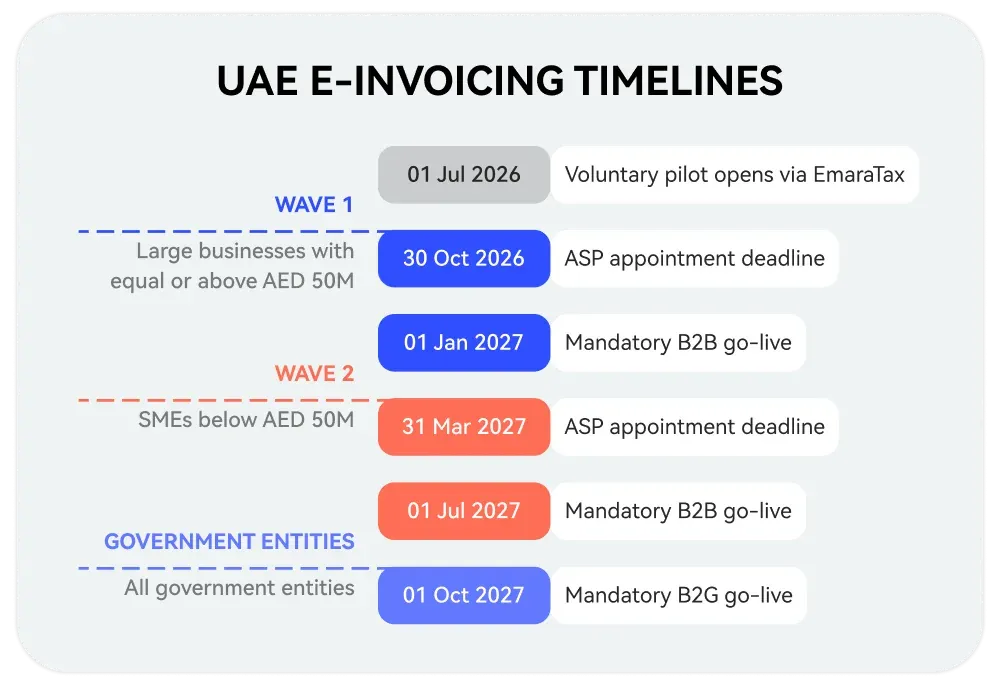
Sitting at or above AED 50 million in revenue? You are Wave 1. Two dates matter for you then. October 30, 2026 to appoint your Accredited Service Provider, January 1, 2027 to go live. Smaller businesses? Mid-2027.
This guide breaks down the model, the PINT-AE format, and what to prepare. In plain English.
Strip away the acronyms and Peppol e-invoicing UAE comes down to a single idea. Machines exchange the invoice data. Machines read it. No human sits in the loop. Suppliers, buyers, accredited service providers, the tax authority, all of them plug into the same standardised, secure framework.
An emailed PDF does not count as the e-invoice. Neither does a scanned paper document. The legal instrument is a structured XML file that software reads directly, without a human retyping anything.
Two decrees carry the whole framework. Scope and exclusions live in Ministerial Decision No. 243 of 2025. The rollout schedule, every wave of it, sits in No. 244. Neither one is pending or draft law; both took effect back in 2025.
The UAE five-corner model is a Decentralized CTC Model where accredited service providers validate and exchange e-invoices between trading partners while transmitting tax data to the government simultaneously.
The official name is the Decentralized Continuous Transaction Control and Exchange (DCTCE) architecture. In practice, the Peppol 5 corner model UAE businesses will operate under works like registered post.
Imagine sending a registered legal document to a business partner. Under standard Peppol, the courier delivers the package directly from your agent to their agent. Under the UAE model, as your courier hands the package over, they slip a certified duplicate straight into the tax inspector's official drop-box at the exact same moment.
The buyer receives their document without delay. The tax authority receives its record instantly.
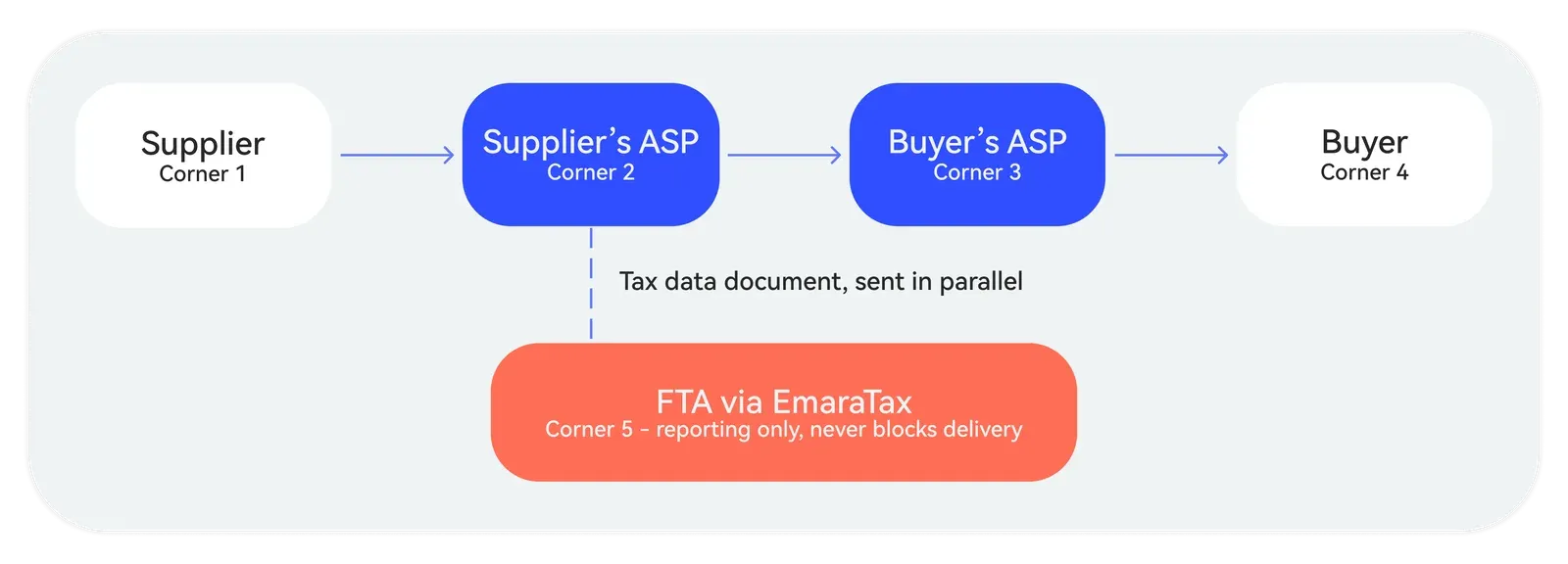
The main difference is the addition of a government endpoint, Corner 5, which receives tax data in real time without blocking or delaying the invoice exchange between buyer and seller.
In the standard 4-corner model, the tax authority sits outside the network entirely. The invoices that move between the parties are still tax invoices, but nothing is reported to the authority as they travel; it reviews transactions after the fact, during audits.
The UAE version changes one thing. Your ASP sends a Tax Data Document to Corner 5 automatically, at the same moment your invoice travels from Corner 2 to Corner 3. Delivery to the buyer is never held up by reporting.
The UAE e-invoicing mandate applies to businesses conducting B2B and B2G transactions in the mainland and free zones, phased by annual revenue, with B2C currently excluded.
Start with your wave. Everything about UAE e invoicing mandate 2026 planning follows from that single answer.
A word of caution on dates. Plenty of older articles still quote July 31, 2026 for the Wave 1 ASP appointment. That date is dead. Ministerial Decision No. 66 of 2026 amended the Wave 1 deadline, extending the ASP appointment date to October 30, 2026. What did not move an inch was the go-live itself: January 1, 2027, same as ever.
Some categories escape the mandate entirely. Under Ministerial Decision No. 243, three carve-outs exist. Sovereign government activities, so long as they do not compete with the private sector. Certain international passenger and goods transport by airlines. And certain exempt financial services. That is the whole list. Peppol e-invoicing UAE reaches everyone else, and yes, that includes free zone entities along with businesses that never registered for VAT.
Three waves, three sets of dates:
One relief worth knowing: transactions within a VAT group get extended time before full obligations apply, with intra-group invoicing expected to join the system from around January 2029. Do not assume the earliest date applies to your group. Check current MoF guidance first.
Three questions settle it:
So what happens when a deadline slips? Cabinet Decision No. 106 of 2025 answers that question in dirhams. AED 5,000 for every month, or part of one, that you operate without an appointed ASP or an activated system.
Each invoice issued outside the system adds AED 100, capped at AED 5,000 per calendar month. The same per-document fine and cap apply to electronic credit notes.
Two daily penalties run alongside those. Failing to notify the FTA of a system failure costs AED 1,000 per day, and so does failing to notify your ASP of changes to your registered data. Voluntary adopters are exempt from all of these until their mandatory wave begins.
Picture a wholesale distributor in Dubai turning over AED 65M. Wave 1, obviously. So the real deadline on their calendar is October 30, 2026, not January's go-live. Blow past it without an ASP in place and Cabinet Decision No. 106 starts charging AED 5,000 a month while the business is still, technically, months away from having to send a single e-invoice.
PINT-AE is the official Peppol International invoice specification adapted for the UAE, defining the mandatory XML data dictionary, VAT rules, and validation logic for every compliant document.
The PINT-AE specification draws a line between two layers. Underneath sits the semantic model, the structured data itself. The layout you actually see on screen sits on top of that.
Emailing a PDF invoice is like mailing a photo of a handwritten letter. Someone still has to sit down, read the thing, then retype every number into an accounting system by hand. Now compare a standardised 2D barcode. Scan it and the data is just there. PINT-AE XML works the same way; line items, TRN identifiers, VAT calculations, all read by the systems on both ends in milliseconds, no human required.
Every field must match the schema, from line-level VAT rates to AED currency conversions. A PDF alone no longer qualifies.
One warning before you lock anything down. Guidance around Peppol e-invoicing UAE is a moving target; the MoF put out Version 1.1 of its Electronic Invoicing Guidelines on June 1, 2026, and that revision alone brought new rules for advance payments and retention amounts. Whatever version you mapped your fields against last quarter may already be stale.
An Accredited Service Provider is an MoF-certified technical vendor authorised to connect your ERP to the Peppol network and transmit Tax Data Documents to Corner 5.
Accreditation is governed by Ministerial Decision No. 64 of 2025, amended in May 2026 to let national companies partner with international providers. The MoF's accredited list already includes more than 30 providers, with others in the final stages of approval, so Wave 1 businesses have real options to compare.
One thing does not transfer with the appointment: responsibility. Your accredited service provider UAE appointment covers transport and formatting, while you remain legally responsible for the accuracy of every invoice.
When comparing providers, check for:
Preparation is mostly a data project, not a software project. Start early.
Voluntary adoption opened on July 1, 2026 via EmaraTax. Any business can opt in before its mandatory wave arrives. Why bother? Because early joiners surface integration problems while mistakes still cost nothing, since penalties never apply during voluntary adoption.
Is UAE e-invoicing based on Standard Peppol?
Yes, the UAE framework runs on Peppol network infrastructure adapted into a 5-corner model. It adds the localised PINT-AE data specification and a direct reporting link to the Federal Tax Authority.
Does the FTA approve every invoice before the buyer receives it?
No. The UAE uses an exchange-first model where the invoice reaches the buyer while tax data travels to Corner 5 simultaneously. Government reporting never blocks or delays delivery to the buyer.
Can businesses still send PDF invoices in the UAE?
Yes, as a copy. Sharing PDFs with customers can continue, but for tax purposes they are not enough on their own once your mandatory wave begins. In-scope B2B and B2G invoices must also be issued as PINT-AE XML through an ASP, and that XML is the legal instrument.
Can you keep your current ERP or accounting software?
Usually, yes. The mandate never says "replace your software." What it says is that Peppol e-invoicing UAE has to flow through an ASP, and the ASP handles the PINT-AE conversion and transmission for you.
What happens if your buyer uses a different ASP than you do?
Nothing changes on your side. Peppol interoperability requires every accredited provider to exchange documents with every other provider on the network, so your ASP routes the invoice to your buyer's ASP automatically. You never need to match providers with your trading partners.
Disclaimer: This article is for informational purposes only and does not constitute formal legal, financial, or tax advice. UAE businesses should consult a qualified tax professional or review official Ministry of Finance guidance for specific compliance determinations.
Somewhere between your ERP and the Federal Tax Authority now sits a company you have probably never heard of, and the law says you must hire one. So, what is AS...
Dubai sells itself. One time zone bridges the European morning and the Asian afternoon, and a short flight reaches Europe, Africa and South Asia. Companies set ...
The UAE e-invoicing requirements are not a future concept anymore. The first wave of businesses faces a hard go-live date of January 1, 2027.
UAE e-invoicing penalties are confirmed, codified, and already in force. The UAE Electronic Invoicing System (EIS) requires businesses to issue, transmit, and r...
Download the app and make your everyday
life more efficient*
* coming in late 2026