UAE E-Invoicing Requirements: Timeline, Rules, and What to Prepare For
The UAE e-invoicing requirements are not a future concept anymore. The first wave of businesses faces a hard go-live date of January 1, 2027.
Dubai sells itself. One time zone bridges the European morning and the Asian afternoon, and a short flight reaches Europe, Africa and South Asia. Companies set up one base here and trade with dozens of markets.
That openness now comes with newer tax machinery.
The UAE electronic invoicing guidelines are that shift, written into law. The Ministry of Finance (MoF) and the Federal Tax Authority (FTA) now require structured, machine-readable invoices that report to the government in near real time.
The rules roll out in waves, biggest companies first, with smaller firms and government bodies following through 2027.
So two things set your timeline: which revenue threshold you cross and how ready your systems already are.
The guidelines replace paper and PDF invoices with structured digital files that tax systems read automatically.
The system, called Decentralized Continuous Transaction Control and Exchange (DCTCE), does one thing. It puts the tax authority inside your invoice flow, live.
So a PDF you email, or a scan you attach? That is no longer an invoice, not in the legal sense. A real e-invoice is structured data. It moves through an approved channel and lands at the FTA almost the second you hit send.
Federal Decree-Law No. 16 of 2024 opened the door. Ministerial Decisions No. 243 and 244 of 2025 filled in the rest: what an e-invoice must hold, and how it travels.
Almost every business trading in the UAE is in scope, including free zone and non-VAT-registered entities.
Run this quick check:
Zero-rated and exempt supplies still need a structured e-invoice, with one carve-out. Financial services that are exempt or zero-rated under Article 42 of the VAT Executive Regulations sit outside the mandate entirely. For everything else, exempt from VAT is not exempt from the format
B2C retail, sovereign government acts, and certain financial and airline services stay outside the rules for now. The carve-outs are narrow. Treat yourself as in scope until you prove you are not.
Your next hard date depends on revenue, and for large taxpayers it is 30 October 2026.
The UAE electronic invoicing guidelines set four rollout waves.
Your deadline tracks your revenue. Four waves, four timelines.
The pilot opens 1 July 2026 for anyone who wants to test early. It is voluntary, no deadline attached.
After that, the mandate lands by size:
One date moved recently. Wave 1's appointment deadline slid from 31 July to 30 October 2026, so large firms got a short reprieve. These timelines come from the Ministry of Finance (mof.gov.ae) and the FTA (tax.gov.ae).
An e-invoice passes or fails on its data, not its design. The UAE electronic invoicing mandatory fields are the line items the system actually inspects.
Every invoice has to name both parties properly: your Tax Registration Number (TRN) and your buyer's TRN, the correct tax category codes, and full line-level detail.If Your Buyer Issues the Invoice for You, Does That Still Count?
What Is an ASP? Each UAE entity also carries a Participant Identifier on the network, built on the 0235 prefix. That string is how the system recognises who you are.
Selling in dollars or euros? You still convert to AED, and only at the UAE Central Bank rate. The PINT-AE invoice requirements set the exact XML attribute behind every one of these fields.
Exporting to a buyer with no Peppol ID still counts. You issue the structured e-invoice and tag them with the export endpoint 0235:9900000099.
Here is where strong teams still slip. Some business classes must map a 10-digit TIN next to the standard 15-digit TRN, and if that pairing is off, the invoice dies inside your own system before it reaches the network.
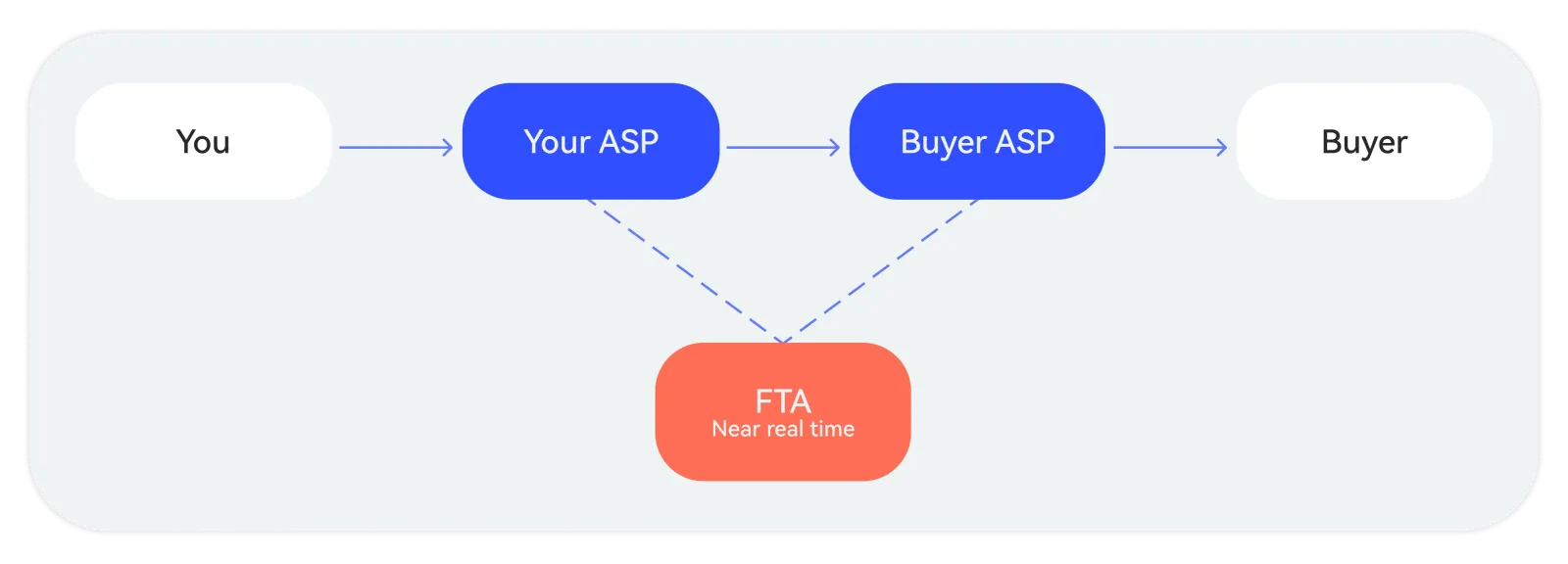
Your accounting software never talks to the tax authority directly. Something sits in the middle, and that is your ASP.
The path is short:
That is the five corners. One invoice, one path, zero email.
The FTA sees the transaction as it clears, not months later in an audit.
XML is mandatory. PDF will fail.
Your wave can start before your customer's does. When it does, you still send the e-invoice to the FTA, and you hand the buyer a readable copy they can use. On the e-invoice, you tag them with the fallback endpoint 0235:9900000098 until they onboard.
Once your ASP transmits an invoice, it is locked. You cannot edit it, and you cannot delete it.
To cancel a deal, drop a price, or correct an error, you issue a structured electronic credit note. It runs through your ASP, links to the original automatically, and must reach the FTA within 14 days of the triggering event.
Miss that window, and your VAT records and your buyer's fall out of sync.
Collect an advance, and you issue an e-invoice the moment it lands. Not at delivery.
Your final invoice then covers only the remaining balance, linked back to that advance invoice through the PINT-AE fields. No double-counting, no broken trail.
Most failures trace back to dirty master data, so clean records come first.
Preparing for the UAE electronic invoicing guidelines comes down to data discipline.
Picture a large trading group running high transaction volumes on a legacy SAP or Oracle setup. If they wait until the go-live window to build custom API connections, they find master-data mapping bugs too late, and billing stalls across the business. Five months of lead time disappears fast.
Heads up: your ASP's validation rules reject a bad invoice before it ever reaches the FTA. A missing 0235 prefix, a blank TRN, or a currency rate not tied to the UAE Central Bank, any one of those bounces the file instantly.
This article is for informational purposes only and does not constitute formal legal or tax advice. Consult a qualified UAE tax professional or reference official Ministry of Finance updates for your specific business scenario.
Sending the invoice is only half the obligation. You also have to keep it.
The FTA wants the original structured XML, not a PDF copy. Convert it to something prettier for your archive and you have technically lost the legal record.
Retention runs five years under the Tax Procedures Law. The clock starts at the end of the tax period, not the invoice date.
Store it anywhere, cloud included, as long as it stays intact, secure, and easy to pull. When the FTA asks for an invoice, you produce it on request.
One catch. You can delegate storage to your ASP, but the legal duty stays with you. The MoF spelled that out in its June 2026 guidelines update.
Fines start small per invoice and compound fast.
Every unstructured invoice draws AED 100, capped at AED 5,000 a month. Miss the ASP deadline, and that AED 5,000 hits you every month until you fix it. Fail to report an API or system outage to the FTA inside two business days, and AED 1,000 stacks up for every day of delay.
Two days max. Delays prompt daily fines.
If your system does go down, the fix is simple: tell the FTA inside those two days, then transmit the held invoices once service is back.
These penalties bite only once you are formally mandated. Voluntary early adopters avoid them.
UAE E-Invoicing: Questions Businesses Ask Most
If your buyer issues the invoice for you, does that still count?
Yes. Self-billing is allowed where both sides are VAT-registered and have agreed it in writing. The buyer issues a structured self-billed e-invoice, and the same fields and deadlines apply.
What is an ASP?
An Accredited Service Provider is an MoF-licensed provider that validates your invoices and transmits them to the FTA over the Peppol network. It is not possible to issue compliant e-invoices without one.
Does each company in your group need its own setup?
Yes. Every entity gets its own Participant Identifier and onboards separately, even if they all run through one ASP.
Can you keep your current ERP?
Often yes, if it can export structured data and link to an ASP. Systems that only spit out PDFs or Excel files will need middleware or an upgrade.
The UAE e-invoicing requirements are not a future concept anymore. The first wave of businesses faces a hard go-live date of January 1, 2027.
UAE e-invoicing penalties are confirmed, codified, and already in force. The UAE Electronic Invoicing System (EIS) requires businesses to issue, transmit, and r...
The UAE e-invoicing timelines are determined. A mandatory phased schedule is upon VAT-registered businesses now. Missing a deadline means penalties start immedi...
Today, many UAE small businesses still issue invoices the same way: a PDF by email, a manual VAT entry, and a follow-up call when payment is late. The benefits ...
Download the app and make your everyday
life more efficient*
* coming in late 2026