
VAT Filing Process in UAE: Step-by-Step Guide for Businesses
The 28th comes around every month or quarter. For every VAT-registered business in the UAE, it means the return is due. EmaraTax guides you through each sectio...
Somewhere in your accounting software sits a template that decides whether an FTA auditor nods or reaches for the penalty schedule. The rules behind a compliant VAT invoice look simple until the exceptions arrive: one format for sales above AED 10,000 to registered buyers, a lighter one below that line, and a structured XML future rolling in through 2027. Three formats, one business, plenty of room to get it wrong.
This guide gives UAE SME owners and finance managers the full picture: what a VAT invoice must show today, when the simplified version is allowed, and how the e-invoicing mandate rewrites both. We cover the current PDF rules first and the XML rules after, because mixing the two is exactly where most teams stumble.
Every VAT registered business in the UAE must issue compliant tax invoices for taxable supplies, and two facts decide the format: your buyer's registration status and whether the amount tops AED 10,000.
Run yourself through the sequence. Registered for VAT? Then each taxable supply needs a valid invoice, issued within 14 days of the date of supply.
Not registered? You issue commercial invoices instead, and the tax invoice rules in this guide do not bind you.
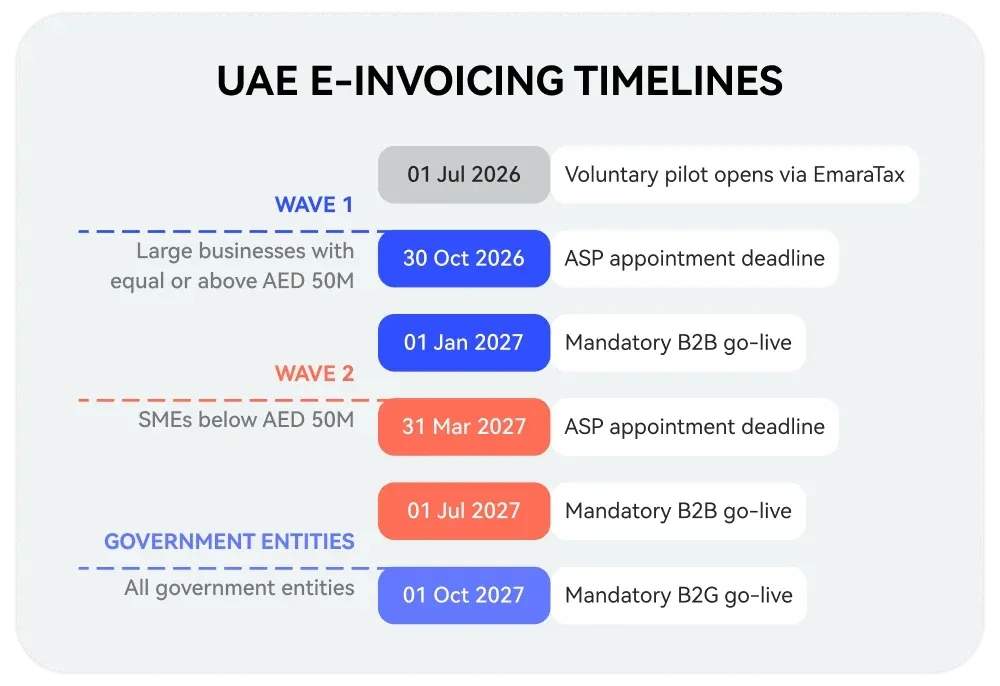
Above or below AED 50 million? Annual revenue of AED 50 million or more places you in Wave 1 of the E-invoicing rollout, live from January 1, 2027. Everyone below that line lands in Wave 2, live from July 1, 2027.
A VAT invoice, legally titled a Tax Invoice, is the document a registered supplier must issue for taxable supplies, recording the parties, the goods or services, the amounts, and the VAT charged.
The law never actually says "VAT invoice." Federal Decree-Law No. 8 of 2017 and its regulations use the term Tax Invoice, so the phrase on the document itself must read exactly that. Everyday business speech treats the two labels as one thing, and for practical purposes they are.
Why does the document carry so much weight? Input tax recovery. Your buyer cannot reclaim the VAT you charged without holding a valid tax invoice, which is why a sloppy template quietly damages your customer relationships long before the FTA ever looks at it.
Article 59 of the VAT Executive Regulations permits a simplified tax invoice when the buyer is unregistered, or when a registered buyer's transaction stays at or below AED 10,000.
The UAE VAT Executive Regulations draw the boundary with unusual clarity. Retail, hospitality, and other high volume B2C sellers live almost entirely in simplified territory. B2B suppliers cross into full invoice territory the moment a registered customer's transaction passes AED 10,000, and many issue full invoices for everything anyway to keep one process instead of two.
The practical differences come down to buyer detail and depth:
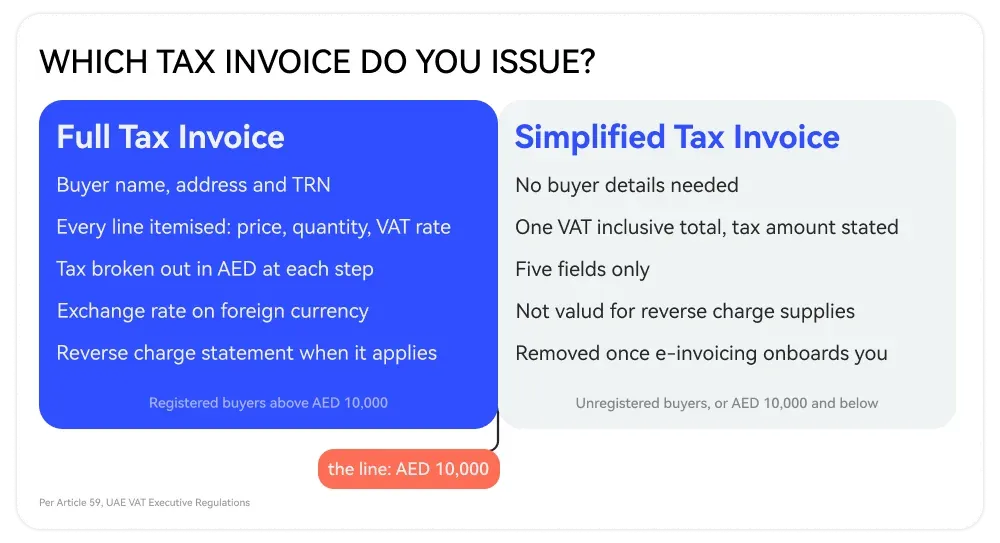
Two limits on the shortcut deserve attention. Simplified tax invoice UAE rules do not extend to reverse charge supplies, where the full format with an explicit reverse charge statement is required. And once your business is onboarded to mandatory e-invoicing, the shortcut disappears altogether, a change we unpack two sections down.
A full tax invoice must display the words Tax Invoice, both parties' details including TRNs, a unique sequential number, the relevant dates, line level pricing with the VAT rate, and dirham totals.
Article 59 spells the full list out. Here it is, translated into checklist form:
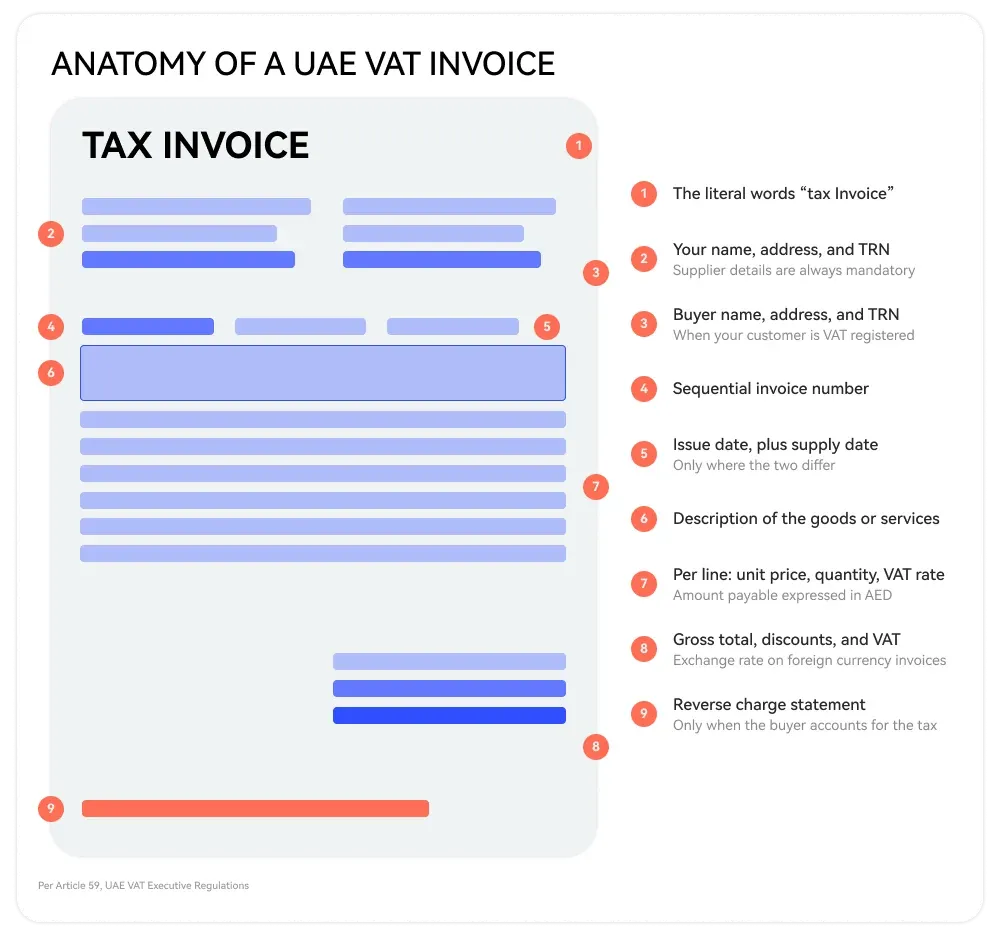
A simplified tax invoice needs only five elements: the Tax Invoice title, your name, address, and TRN, the issue date, a description of the supply, and the VAT inclusive total.
Five elements, one page, done.
E-invoicing readiness is a data mapping project, not a design project: your ERP fields must align with the PINT AE data dictionary before your ASP can validate and transmit anything.
The content requirements barely move; the container transforms completely. From your mandatory wave onward, in-scope B2B and B2G invoices must travel as structured PINT AE XML through an Accredited Service Provider.
A PDF invoice is a photograph of a boarding pass. A human reads it fine, but the airport gates cannot scan it. A structured XML e-invoice is the barcode itself, machine readable data the FTA's systems process the instant it moves.
The calendar is fixed. Wave 1 businesses, at AED 50 million revenue or above, must have an ASP appointed by October 30, 2026 and exchange live e-invoices from January 1, 2027. Wave 2 covers everyone below the threshold, with an appointment deadline of March 31, 2027 and go-live on July 1, 2027, while government entities switch on from October 1, 2027.
Now the part that catches finance teams off guard. Cabinet Decision No. 100 of 2025 amended the Executive Regulations from September 29, 2025, and it removes the simplified invoice option once a business is mandatorily onboarded to e-invoicing. Every field matters then; you use the full schema.
Consider a Sharjah trading company turning over AED 30 million. Comfortably Wave 2, its finance manager assumed the accounting package's PDF generator had the transition covered, then discovered in a readiness review that nothing in the stack could produce the PINT AE mandatory fields or reach the Peppol network without an accredited provider. The template was never the problem; the pipes were.
Preparing for e-invoicing is house plumbing, not house painting. Redesigning your visual invoice template is painting the walls. The real work is connecting the pipes: mapping your internal ERP fields to the PINT AE data dictionary so your ASP can validate and transmit every document.
The latest Electronic Invoicing Guidelines V1.1, dated June 1, 2026, added clarifications your mapping exercise should absorb now.
Most rejected or penalised invoices fail on small mechanical points: a wrong TRN, a missing title, absent exchange rates, or a document issued outside the 14 day window.
Start with the identifier everyone assumes is right. Buyer TRNs get copied from old emails, mistyped, or carried over after a customer restructures, and tax registration number TRN validation through the FTA's lookup tool on EmaraTax takes seconds. Build it into customer onboarding rather than invoice review.
The other frequent offenders form a short, expensive list. Documents missing the literal words "Tax Invoice" sit alongside foreign currency invoices that never convert the tax amount to AED at the applicable rate. Reverse charge supplies arrive with no reverse charge statement, and invoices raised weeks after the supply date breach the 14 day rule, which under the penalty framework applying from April 2026 can cost AED 2,500 per detected case.
None of these mistakes involves difficult judgement. Each one is a process gap, and process gaps are fixable this quarter.
A well built template hardwires the mandatory fields into every document you issue, so compliance stops depending on whoever happens to raise the invoice that day.
Think of an FTA compliant invoice template as a checklist that fills itself in. The title, your TRN, the sequential numbering, the AED conversion line, the reverse charge wording: all present by default, none reliant on memory. Staff turnover stops being a compliance event.
A note of honesty here. A template designed to support the invoice information requirements in current UAE guidance is a strong foundation, not a certificate. Validity also depends on the transaction's nature, your supplier status, and the VAT treatment applied, which is where professional review earns its fee.
And an FTA compliant invoice template built today should be built with 2027 in mind. Structure your underlying data to PINT AE logic now, and the visual layer becomes the easy part of your Wave 2 project instead of a false comfort.
What is the difference between a tax invoice and a VAT invoice?
Nothing in substance. UAE law uses the term Tax Invoice, while VAT invoice is the everyday name for the same document. The words printed on the document itself must read "Tax Invoice."
When can a simplified tax invoice be used in the UAE?
When the buyer is not registered for VAT, or when a registered buyer's transaction is AED 10,000 or less. The option falls away once your business is mandatorily onboarded to e-invoicing under Cabinet Decision No. 100 of 2025.
Can I issue a UAE VAT invoice without a TRN?
No. Only VAT-registered businesses can issue a tax invoice, and your own TRN must appear on every one. The buyer's TRN is required only on full tax invoices issued to VAT-registered customers.
Is a PDF invoice valid for UAE e-invoicing?
No. A PDF is a visual format, and once your mandatory rollout wave begins, in-scope invoices must be transmitted as structured PINT AE XML through an Accredited Service Provider. A PDF alone will not meet the structured requirements from that point.
Disclaimer: This article is for informational purposes only and does not constitute legal or tax advice. UAE VAT and e-invoicing rules continue to evolve; consult a qualified UAE tax professional or official Ministry of Finance and FTA guidance for your specific situation.
The 28th comes around every month or quarter. For every VAT-registered business in the UAE, it means the return is due. EmaraTax guides you through each sectio...
If this is your first time filing corporate tax in the UAE, you're not behind. You're just early in a process most business owners are still getting used to.
VAT in Dubai is exactly 5%. One rate, applied uniformly across all seven emirates. No exceptions by location. But how much is VAT in Dubai as a business owner i...
Dubai has a well-earned reputation for zero personal income tax. Corporate tax tells a different story. The UAE introduced a 9% corporate tax rate in 2023, appl...
Download the app and make your everyday
life more efficient*
* coming in late 2026