
VAT Invoice UAE: Format and Mandatory Fields Explained
Somewhere in your accounting software sits a template that decides whether an FTA auditor nods or reaches for the penalty schedule. The rules behind a compliant...
If this is your first time filing corporate tax in the UAE, you're not behind. You're just early in a process most business owners are still getting used to.
UAE corporate tax only started applying to financial years from June 2023 onward, so plenty of people are sitting down to do this with no muscle memory and a list of unfamiliar terms. That unfamiliarity, more than the tax itself, is usually what keeps owners up at night.
Here's the part that should ease your mind. How to file corporate tax in UAE breaks down into a handful of repeatable steps, not a maze of legal language.
Your Four-Step Roadmap
Work out if you're in scope, register on EmaraTax, keep seven years of records, and submit your return within nine months of your financial year end.
Here's the full breakdown and 2026 deadlines.
This article is for informational purposes only and does not constitute legal or tax advice. Consult a qualified UAE tax professional for your specific compliance requirements.
Mainland vs Free Zone Companies
Mainland and free zone companies have different rules. But almost everyone has to register. Mainland businesses pay 0% on profits up to AED 375,000 and 9% above that line. Free zone companies can access the same 0% rate on qualifying income, but only if they meet the Qualifying Free Zone Person conditions set by the Ministry of Finance.
The AED 375,000 Taxable Income Threshold
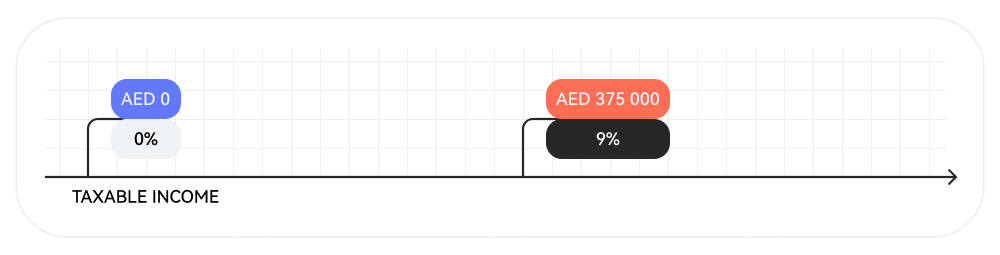
AED 375,000 decides your tax rate, not your filing obligation. Income below it is taxed at 0%, and income above it at 9%. Either way, you still need corporate tax registration UAE status, and you still need to file.
Not sure if any of this applies to you? Run through this checklist.
You operate as a mainland business in the UAE: you need to register and file.
You operate as a free zone company with or without confirmed QFZP status: you need to register and file.
Your taxable income sits above AED 375,000: you owe 9% on the amount above that line.
Your taxable income sits below AED 375,000: you still register and file, just at 0%.
You're unsure which category fits you: treat yourself as in scope until a tax professional confirms otherwise.
Visit the FTA's centralized EmaraTax portal and create your account, or use your existing EmaraTax corporate tax login if you've already registered for VAT. Then request a TRN specifically for corporate tax, separate from any VAT TRN you already hold.
Gather your invoices, bank statements, payroll records, and financial statements. Sort everything by financial year. Corporate Tax Law requires you to store all of it for seven years.
Your taxable income starts out as accounting profit. Then it gets adjusted for items the FTA treats differently, things like exempt income or expenses you can't deduct. Check that adjusted number against the AED 375,000 mark. Below it, you owe nothing.
Above it, you owe 9% on the difference. Get this number wrong, and your whole return is wrong.
Log back into EmaraTax once your numbers are final. Upload your return with the supporting figures from Step 3. The portal walks you through each field, and most filers finish within the hour.
Payment runs through the same EmaraTax portal, using your TRN as the reference. You can pay by bank transfer or card. Keep the confirmation with your other seven-year records.
Mark your calendar now. The UAE corporate tax deadline 2026 follows one rule everywhere: nine months after your financial year end, set out under Federal Decree-Law No. 47.
Here's how that plays out depending on your FYE.
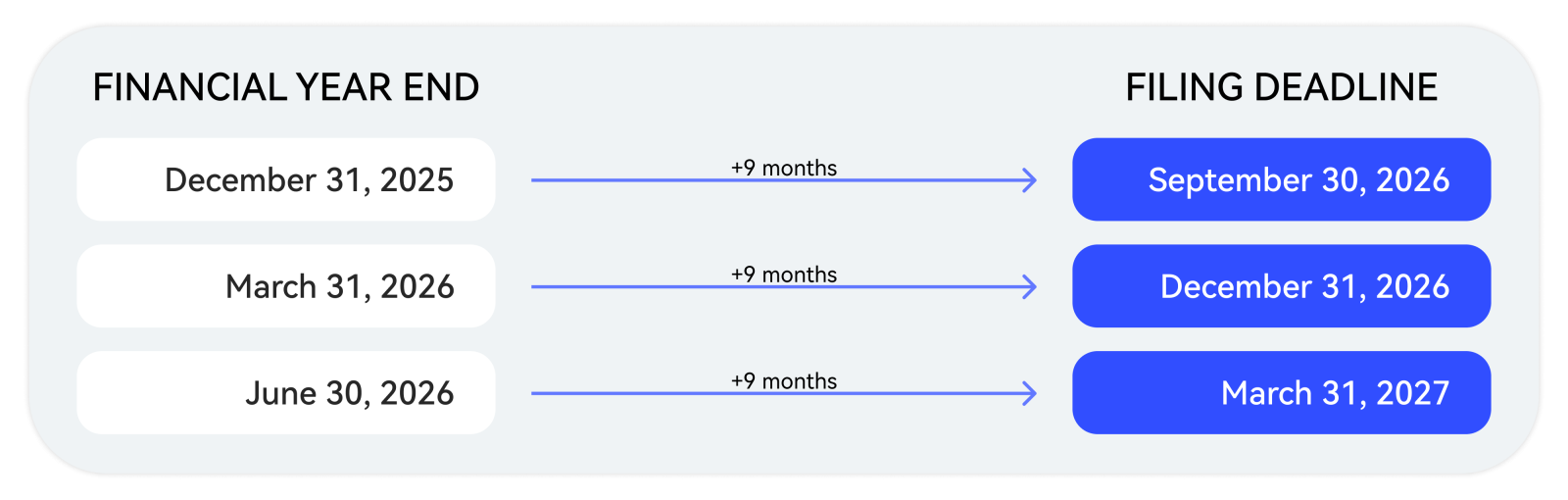
Miss this date, and penalties start accruing. There's no grace period built into the law.
Before you can file corporate tax in UAE properly, gather five things: financial statements, sales and expense invoices, bank statements, payroll records, and your TRN confirmation. Keep digital copies. Paper receipts fade.
PDFs don't, as long as you back them up.
A lot of small UAE businesses end up paying nothing in corporate tax, despite profit that's well above AED 375,000. If you keep your revenue at or under AED 3 million, both this tax period and every one before it, you could qualify for Small Business Relief under Article 21 of the Corporate Tax Law.
Elect it on your return, and the FTA treats you as having no taxable income for that period. You also get to use cash basis accounting instead of accrual, which trims a fair amount of bookkeeping work.
It is not automatic.
And it isn't for everyone. Qualifying Free Zone Persons can't claim it, and neither can entities belonging to a multinational group with consolidated revenue above AED 3.15 billion. The relief currently only covers tax periods ending on or before December 31, 2026, so treat it as a window rather than a permanent feature.
Your revenue is AED 3 million or less, this year and every prior tax period.
You're not a Qualifying Free Zone Person already claiming the 0% rate.
You're not part of a large multinational group.
You're a UAE resident person for tax purposes.
If all four apply, you can elect Small Business Relief directly on your corporate tax return through EmaraTax.
Decision No. 75 of 2023 sets a flat AED 10,000 penalty for missing your registration deadline. Since April 2025, the FTA has waived this penalty for anyone who registers late but still files their first tax return within seven months of their tax period ending, refunding it if you'd already paid.
Filing your return late is a separate problem, and it's billed by the month. The penalty starts at AED 500 a month for the first twelve months, then climbs to AED 1,000 a month after that, with no cap on how long it can run.
Then there's the mistake that surfaces after you've already filed: a wrong figure, a missed exemption, a Small Business Relief election you forgot to make. The fix is a voluntary disclosure, correcting the error yourself before the FTA finds it. It almost always costs less than waiting to get caught.
Once you've worked through how to file corporate tax in UAE this cycle, next year's deadline will feel far less stressful.
What documents are required for corporate tax in UAE?
You must maintain financial statements, sales and expense invoices, bank records, and payroll data, all stored for seven years under UAE Corporate Tax Law.
What is the corporate tax threshold in UAE?
AED The UAE corporate tax rate is 0% on profit up to AED 375,000 and 9% on profit above that.
How do you file corporate tax in UAE?
Register for a TRN and submit your corporate tax return through the FTA's EmaraTax portal, due nine months after your financial year ends.
Do all UAE companies need to file corporate tax?
Yes. Most mainland and free zone businesses must register and file, even if their income falls below the AED 375,000 threshold, qualifies for the 0% rate, or qualifies for Small Business Relief.
What happens if you file your corporate tax return late?
Late filing penalties start at AED 500 a month for the first twelve months, then rise to AED 1,000 a month after that. There's no cap, so the cost keeps climbing the longer a return goes unfiled.
Somewhere in your accounting software sits a template that decides whether an FTA auditor nods or reaches for the penalty schedule. The rules behind a compliant...
The 28th comes around every month or quarter. For every VAT-registered business in the UAE, it means the return is due. EmaraTax guides you through each sectio...
VAT in Dubai is exactly 5%. One rate, applied uniformly across all seven emirates. No exceptions by location. But how much is VAT in Dubai as a business owner i...
Dubai has a well-earned reputation for zero personal income tax. Corporate tax tells a different story. The UAE introduced a 9% corporate tax rate in 2023, appl...
Download the app and make your everyday
life more efficient*
* coming in late 2026