
VAT Filing Process in UAE: Step-by-Step Guide for Businesses
The 28th comes around every month or quarter. For every VAT-registered business in the UAE, it means the return is due. EmaraTax guides you through each sectio...
VAT in Dubai is exactly 5%. One rate, applied uniformly across all seven emirates. No exceptions by location. But how much is VAT in Dubai as a business owner is a very different question. Consumers see a flat surcharge at checkout. As a business, the 5% rate is just the starting point. There are registration thresholds, invoice rules, and a major e-invoicing shift all in play.
The VAT rate is 5% in Dubai. The FTA administers it federally across the entire UAE.
It applies to most taxable supplies, from consulting fees to retail goods. Specific categories are zero-rated or exempt. We cover both below.
No, there is no separate Dubai rate. The UAE runs a single federal VAT system and all seven emirates follow it. Your Tax Registration Number (TRN) works across the whole country.
Consumers
Consumers pay 5% at the point of sale on most purchases. The business collects it and remits it to the FTA.
VAT-Registered Businesses
Registered businesses collect VAT on their taxable supplies and can claim input tax recovery on eligible costs. That reclaim is filed via a federal tax authority VAT return submitted through the EmaraTax portal.
Businesses Not Registered for VAT
No TRN means no VAT charge.
No, not every business has to. Only those registered with the FTA are authorised to charge VAT on their taxable supplies.
Check your position in three steps:
Total your taxable supplies and imports over the past 12 months
Project your taxable supplies over the next 30 days
Compare both figures to the statutory registration thresholds in the next section
Cross the line on either measure and you have to register. No exceptions.
Two thresholds govern registration. Both are calculated on gross taxable supplies and imports, not net profit.
UAE VAT registration threshold is AED 375,000. If it is exceeded in any rolling 12-month period, registration becomes mandatory. Voluntary registration opens at AED 187,500, which allows you to reclaim input tax before crossing the mandatory line.
Let’s assume a DMCC-registered consultant billing AED 30,000 a month.
By month 13, they have crossed AED 375,000. Businesses generally track by calendar year. The FTA does not. Missing the rolling window results in an AED 10,000 penalty for late registration under Cabinet Decision No. 106 of 2025.
Most commercial transactions attract the standard 5% rate. Professional services, retail, hospitality, construction, and most imports sit at 5%.
Healthcare, education, international exports, and residential rentals are a different story. Those may qualify for zero-rated or exempt treatment instead. Where your supply falls determines how you invoice and whether you can recover input costs.
The question of how much is VAT in Dubai gets more complex when you operate across mixed supply types, where one service line is standard-rated and another qualifies as exempt.
Yes. Zero-rated supplies and exempt supplies both sit outside the standard 5% rate. They are not the same thing.
Zero-rated supplies allow full input tax recovery on production costs. Exempt supplies do not allow this. That difference directly impacts the cash position.
Zero-rated goods include exports, international transport, and qualifying healthcare services. Exempt supplies cover residential rental and certain financial services. Out of scope supplies, such as employee wages, fall entirely outside the UAE VAT framework.
A tax invoice must satisfy the FTA's mandatory field requirements. Missing even one field can invalidate the document.
The VAT invoice format UAE businesses must follow:
"Tax Invoice" clearly displayed on the document
Full legal business name, address and Tax Registration Number
A sequential invoice number and issue date
A clear description of goods or services supplied
Net amount, VAT rate and VAT amount listed separately
Total amount payable including VAT
The UAE is moving to mandatory structured electronic invoicing. The format of a compliant tax invoice is changing.
Under the new rules, PDF invoices will no longer fulfill FTA requirements for registered businesses. The invoices must be issued in structured XML using the PINT-AE format. In this format, every field, from your TRN to the line-item VAT breakdown, is individually tagged and machine-readable. The FTA validates each one automatically through EmaraTax.
To send compliant invoices, you need to connect to an Accredited Service Provider (ASP). The ASP sits between the invoicing system and the FTA's Electronic Invoicing network. It validates the invoice structure against Ministerial Decision No. 243 of 2025 and logs the confirmed transaction before delivery.
UAE E-Invoicing Deadlines
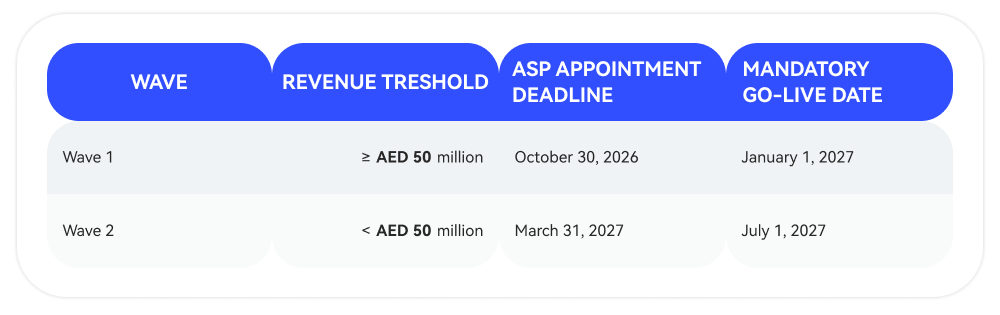
Both waves fall under the UAE Electronic Invoicing Guidelines Version 1.0, published February 23, 2026.
FAQs about VAT in Dubai
Is VAT always 5% in Dubai?
For most transactions, yes. The standard rate across the UAE is 5%, though specific goods and services are zero-rated or fully exempt under Federal Tax Authority rules. To calculate 5% VAT UAE on any taxable amount, multiply the net figure by 0.05.
Do tourists pay VAT in Dubai?
Definitely. Tourists pay 5% at the point of sale on taxable purchases. Eligible goods qualify for a VAT refund. Claiming it at the digital tax-free validation counters is possible before leaving through any UAE port of exit.
What happens if I charge VAT without being registered?
The FTA treats it as a serious breach. Charging VAT without a TRN can result in penalties and force repayment of the amounts wrongly collected. If your turnover is approaching the UAE VAT registration threshold, register before you charge.
Do free zone businesses in Dubai need to charge VAT?
It depends on who you are selling to. Free zone businesses supplying into the UAE mainland market are generally subject to VAT. Supplies made within a designated free zone, or between free zones, may be treated differently.
The 28th comes around every month or quarter. For every VAT-registered business in the UAE, it means the return is due. EmaraTax guides you through each sectio...
If this is your first time filing corporate tax in the UAE, you're not behind. You're just early in a process most business owners are still getting used to.
Dubai has a well-earned reputation for zero personal income tax. Corporate tax tells a different story. The UAE introduced a 9% corporate tax rate in 2023, appl...
Download the app and make your everyday
life more efficient*
* coming in late 2026