UAE Electronic Invoicing Guidelines: How to Prepare Your Business
Dubai sells itself. One time zone bridges the European morning and the Asian afternoon, and a short flight reaches Europe, Africa and South Asia. Companies set ...
Globalization, automation, and AI are reshaping how businesses process financial data. In the UAE, that shift has a regulatory deadline attached to it. The pdf vs e-invoice UAE distinction is no longer theoretical. PDF invoices do not fulfill the Federal Tax Authority's Electronic Invoicing System (EIS) requirements. A PDF-based workflow will not pass FTA validation.
Is a PDF invoice the same as an e-Invoice in the UAE?
No. A PDF is a visual document built manually for human perception. A UAE e-invoice is structured XML data built for machine perspective. The FTA's system needs to read, validate, and route every invoice automatically through a government-approved gateway. A PDF is not able to do any of that. It is static. It has no machine-readable fields. The system cannot process it.
This is not a formatting preference. It is a structural difference with legal consequences.
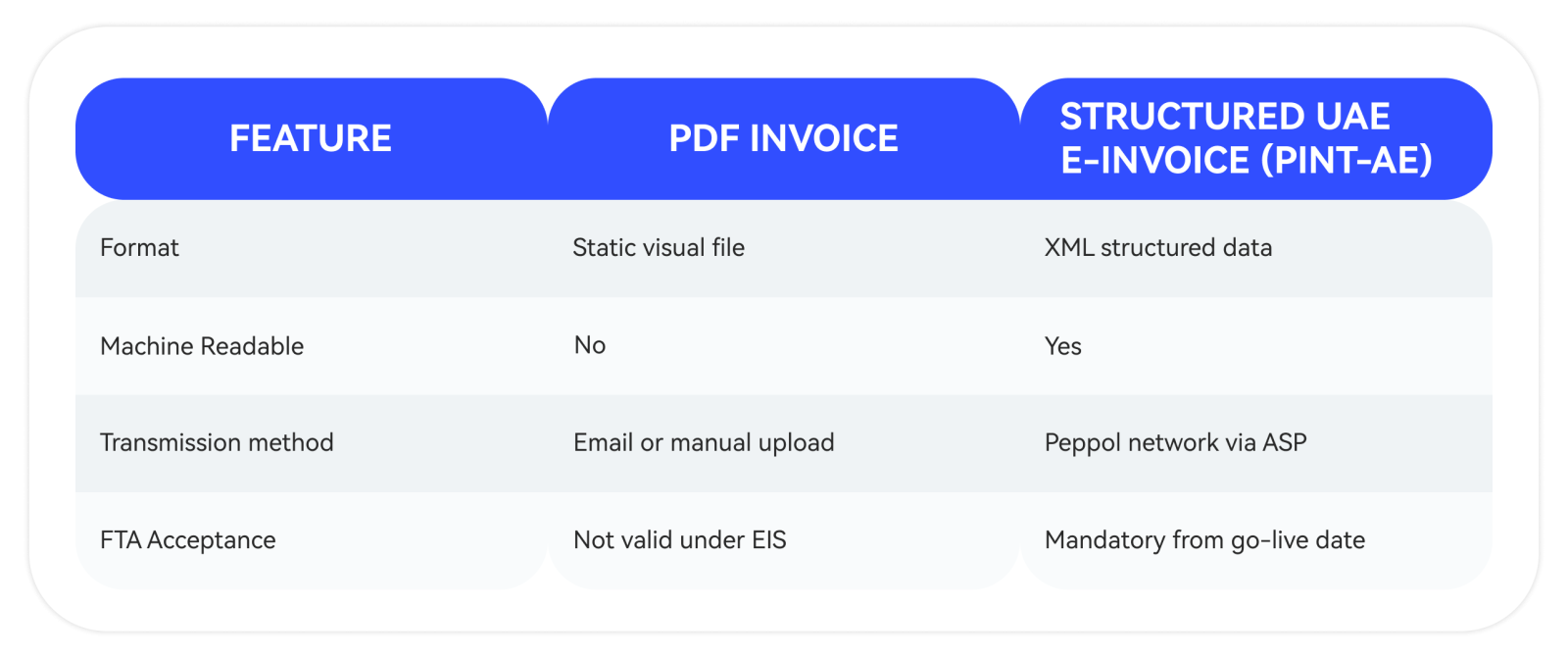
The UAE has adopted PINT-AE as its national e-invoicing standard, and all businesses within scope are required to use it. PINT-AE v1.0 is built on the Peppol BIS Billing specification. It is adapted for UAE VAT rules and Arabic language requirements. Every mandatory data field, like supplier TRN, buyer TRN, line-item tax amounts, and invoice currency, must be present. Every field must be accurately mapped and machine-readable inside that XML file
A PDF might contain the same information. But the FTA's platform cannot extract it, validate it, or clear it. That is the fundamental problem.
The UAE EIS is built on the 5-corner Peppol model. Steps in that chain are fixed:
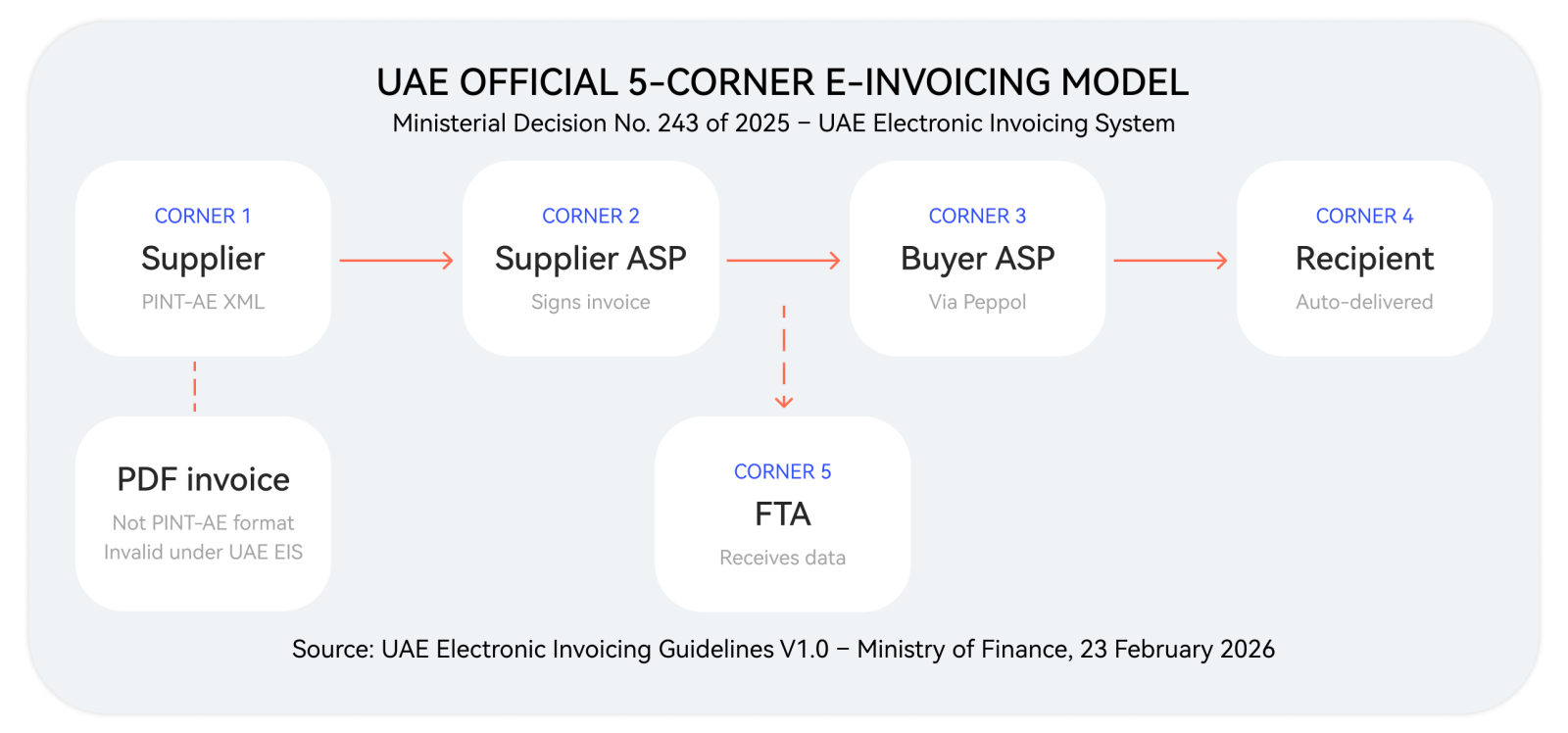
A PDF has no potential to enter this chain at step one. There are no structured fields for an ASP to read. It cannot carry a compliant digital signature. Sending a PDF into this process is the equivalent of handing a paper letter to a courier and asking them to route it through a fully automated e-gate. It will not pass.
There is also a timing dimension. Under Cabinet Decision No. 106 of 2025, the structured e-invoice FTA framework requires cleared invoices to be delivered within a defined window. The pdf vs e-invoice UAE gap is exactly why that clearance step exists. PDFs have no path through it.
Data quality problems are another dimension. Your TRNs, registered trading addresses, and buyer details must match your EmaraTax records precisely. The EIS will reject invoices with mismatches. Automatically. No manual override.
The UAE e-invoicing mandate 2026 refers to the regulatory framework published jointly by the Ministry of Finance (MoF) and the FTA. Go-live dates are phased by annual revenue threshold.
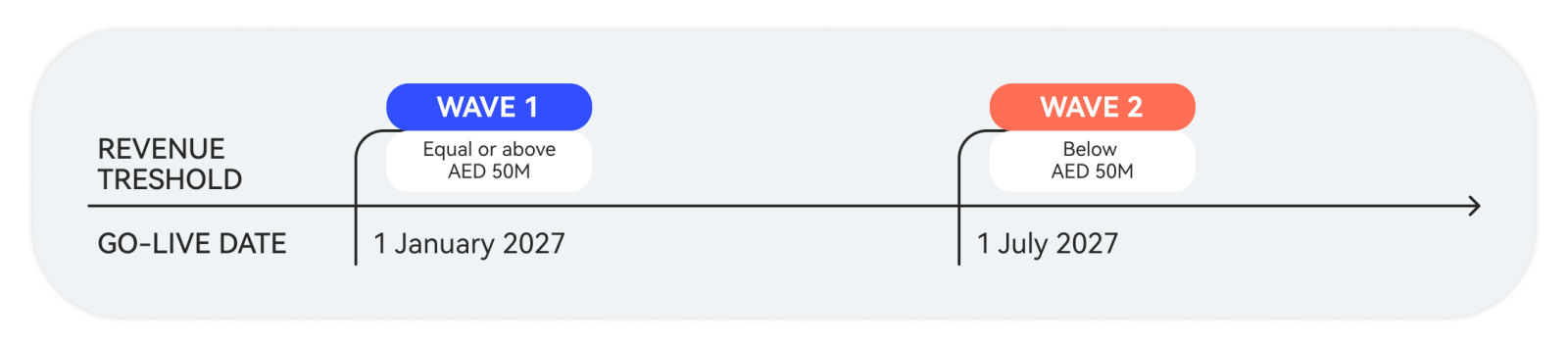
The gap between those dates may feel generous until you factor in ASP onboarding, software integration, and master data cleanup. Each one takes longer than expected.
It is not possible to self-certify for UAE e-invoicing. Every business transacting B2B or B2G invoices must use a licensed Accredited Service Provider UAE. An ASP is a certified technology intermediary that connects the invoicing software to the Peppol network and the FTA's EmaraTax platform.
When evaluating an ASP, three criteria matter above everything else:
A provider who is vague on that third point is a risk you do not want near a compliance deadline.
Before signing with any ASP, confirm their system has been validated against the mandatory field requirements in Ministerial Decision No. 243. Two questions worth putting to them directly: how do they handle clearance failures, and how fast can they resubmit? Vague answers on either point are a warning sign.
If you cannot tick all six today, start with the top two. TRN and address mismatches are the most common rejection reasons under the EIS.
Yes, for B2B and B2G transactions. From your wave go-live date, invoices must be issued through the EIS. PDFs are valid for record-keeping only.
Yes, as a supplementary document. The XML is the legally valid invoice under the FTA mandate. The PDF is a convenience copy, not a substitute.
Your ASP sends you the rejection code and the affected field. Correct it and resubmit. Unresolved rejections within the clearance window become compliance gaps on your record.
Yes, unless your software is itself FTA-accredited or has a certified ASP integration built in. Verify your provider's status at tax.gov.ae before assuming coverage.
Dubai sells itself. One time zone bridges the European morning and the Asian afternoon, and a short flight reaches Europe, Africa and South Asia. Companies set ...
The UAE e-invoicing requirements are not a future concept anymore. The first wave of businesses faces a hard go-live date of January 1, 2027.
UAE e-invoicing penalties are confirmed, codified, and already in force. The UAE Electronic Invoicing System (EIS) requires businesses to issue, transmit, and r...
The UAE e-invoicing timelines are determined. A mandatory phased schedule is upon VAT-registered businesses now. Missing a deadline means penalties start immedi...
Download the app and make your everyday
life more efficient*
* coming in late 2026