How to Choose an Accountant for Your Small Business in the UAE
A few years ago, a spreadsheet and one year-end visit covered most small firms. Corporate Tax ended that era. Knowing how to choose an accountant for a small bu...
No local sponsor is needed. If you want to start a business in UAE as a foreigner, the formation process is faster than most expect. The real challenge is what comes after: VAT registration, Corporate Tax, banking, and invoicing compliance.
In this 2026 guide, we explain everything you need to set up a business in UAE as a foreigner, in order.
Before you spend anything, run through these:
How to Start a Business in UAE as a Foreigner: The 9-Step Process
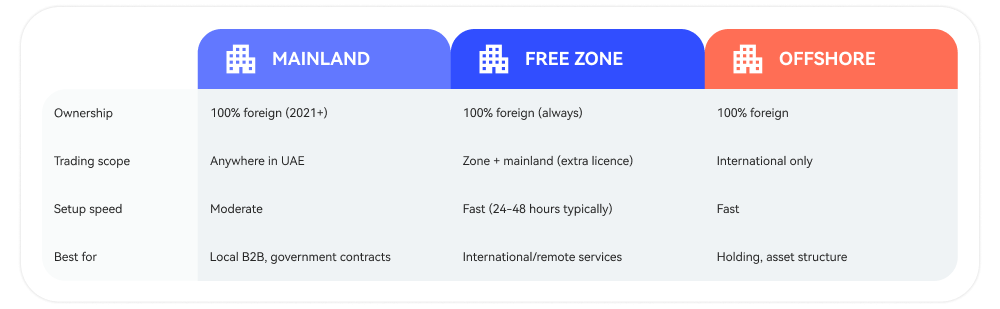
Three routes, three different scopes:
The deciding question: who are your clients?
Mainland clients point to a Mainland licence. International or remote services point to a Free Zone.
The licence is not just paperwork. It defines what you can legally do. Operating outside it is a compliance breach. Commercial, Professional, and Industrial are the main categories.
Every Free Zone and DED office publishes an approved activity list. Check it before you apply. Adding activities after the fact costs extra and slows things down.
The UAE has clear naming restrictions. Religious references are out. So are offensive terms and anything that sounds like a government body. If your own name features in it, use your full legal name.
Most foreign founders go with an FZ-LLC in Free Zones or an LLC on Mainland. Reserve your name early. Reservation fees are low; delays from a rejected name are not.
Initial approval means the government is satisfied with your proposed activity and structure. It is not the final licence, so do not sign leases or move capital before you have it in hand.
Once initial approval comes through, you submit the full application. Simple Free Zone setups can clear in a day or two. Healthcare, finance, and education are regulated activities. Those take considerably longer.
Standard requirements:
Passport copy, valid at least 6 months beyond your setup date
Passport-size photos (white background; check dimension requirements per authority)
Business plan (some Free Zones require it, particularly for regulated activities)
Bank reference letter (jurisdiction-dependent)
Completed application forms
Setting up a branch of an existing foreign company? Add attested parent company registration documents, Articles of Association, and a board resolution to your pack. Foreign documents need apostille certification before UAE authorities will accept them, and some countries require notarisation on top of that.
Check what applies to your source country well before your submission date.
You do not need to be a UAE resident to hold a licence. Many Free Zones allow full remote formation, though a residence visa is usually needed to open a local bank account.
Investor visas run 2 to 5 years and are renewable. Each licence has a set visa allocation based on office space and Free Zone rules. Plan your headcount before committing to a package.
Banking takes longer than almost every founder expects. Budget 4 to 8 weeks from licence issuance.
Prepare a full pack before approaching any bank:
Memorandum of Association
Trade licence and certificate of incorporation
Shareholder passports; Emirates ID if you already have UAE residency
Clear description of your business model and expected transaction flows
There is no federal minimum balance rule. Each bank sets its own, and monthly average requirements commonly run between AED 10,000 and AED 50,000 before fees kick in.
Digital banks like Wio offer faster onboarding. Traditional banks offer broader infrastructure but stricter standards.
If your taxable revenue is heading toward the mandatory VAT registration threshold of AED 375,000, do not wait until you cross it. Register through EmaraTax beforehand. Once approved, you get your Tax Registration Number, your TRN, which goes on every invoice from that point forward.
Corporate Tax registration is mandatory for all UAE businesses, profitable or not. Also handled through EmaraTax. Profits above AED 375,000 are taxed at 9%.
Below that, the rate is zero.
Free Zone companies are subject to Corporate Tax but may qualify for a 0% rate on Qualifying Income under strict QFZP criteria. Check the specific 0% exemptions under the Corporate Tax regime before assuming exemption applies.
UAE law sets two retention floors: 5 years for VAT records, 7 years for Corporate Tax. Both clocks start from your first transaction.
Get your accounting and invoicing system in place before that first sale. A VAT invoice has mandatory fields: your TRN, the invoice date, VAT broken out by rate, and complete details for both supplier and customer. Leave any of those out and the invoice is non-compliant. Your client cannot claim input tax credit on it, and you are exposed to FTA penalties.
Take Marco, a 45-year-old Dutch national running an online professional services consultancy. His consultancy turns over seven figures, serves EU clients, and runs entirely remotely.
He incorporates a Free Zone LLC in Dubai in mid-2026 and decides accounting can wait until the business picks up locally. Invoices go out on a basic PDF template from day one.
Three months in, a UAE-based client requests a VAT-compliant invoice to reclaim input tax. Marco's invoices are missing the TRN and the VAT breakdown by rate. Every invoice issued to date is non-compliant. He now faces a retroactive correction exercise, a potential FTA audit flag, and a billing dispute with his first major local client.
The fix would have taken one afternoon at incorporation. It did not happen because nobody flagged it as Day One work. That is the gap this step is designed to close.
The UAE e-invoicing mandate is live and applies to every business without exception. Annual revenue of AED 50 million or above puts you in Wave 1: appoint your ASP by October 30, 2026, and go live by January 1, 2027.
Below AED 50 million, you are in Wave 2: ASP appointed by March 31, 2027, go-live July 1, 2027. New businesses should identify their wave at incorporation and appoint an ASP accordingly, not at the deadline.
PDF invoices do not satisfy the requirements where the mandate applies. The required format is PINT-AE, a structured XML standard built on the global Peppol framework. Failure to appoint an Accredited Service Provider before your wave deadline carries a penalty of AED 5,000 per month under Cabinet Decision No. 106. The clock starts at the deadline, not at go-live.
Wrong jurisdiction for their client base: A Free Zone entity cannot always contract directly with UAE mainland clients. If your market is local B2B, address this at setup, not after.
Underestimating banking timelines. Most founders think account opening takes a week or two. It rarely does. Start the process the moment your licence lands.
Skipping attestation checks. A document that is not properly apostilled gets rejected outright. There is no workaround. Check what your source country requires before you submit anything.
Treating the licence as the finish line. The licence gets you started. VAT registration, UAE Corporate Tax registration, and your accounting setup are all separate steps, and all of them sit with you, not the Free Zone authority.
Can a foreigner own 100% of a UAE business?
Yes, for most activities. The 2021 Companies Law reform made it standard on Mainland. Free Zones have always worked that way.
Can I set up a UAE company without visiting the country?
Most Free Zones support full remote formation. You will likely need to visit once for banking, since many banks require in-person verification before opening a business account.
What Does It Cost to Set Up a UAE Business?
Free Zone packages with a visa typically start from AED 10,000 to AED 15,000. Mainland costs more, especially where a physical office is involved. The headline figure rarely tells the full story, so always ask for an itemised breakdown.
What is the best business to start in UAE as a foreigner?
The short answer: whatever sector you already know well. E-commerce, tech consulting, and digital marketing are common choices, but Free Zone advantages apply across many sectors.
Do free zone companies pay corporate tax?
Yes. The standard rate is 9%. A 0% rate applies only to Qualifying Income earned by a Qualifying Free Zone Person under the Corporate Tax Law. The criteria are narrow. Confirm with a UAE tax adviser before treating your entity as exempt.
A few years ago, a spreadsheet and one year-end visit covered most small firms. Corporate Tax ended that era. Knowing how to choose an accountant for a small bu...
A laptop, a Wi-Fi connection, and a bit of nerve. That sits closer to the real starting line than any business degree. Many of the best online business ideas in...
You do not need a lot of money to start a business in Dubai. The best business ideas in Dubai with low investment in 2026 are all service-based: consulting, dig...
Setting out on your own as a freelancer? Or building a small team with a real company behind it? Either way, the real question is how to become an entrepreneur ...
Download the app and make your everyday
life more efficient*
* coming in late 2026