How to Choose an Accountant for Your Small Business in the UAE
A few years ago, a spreadsheet and one year-end visit covered most small firms. Corporate Tax ended that era. Knowing how to choose an accountant for a small bu...
Setting out on your own as a freelancer? Or building a small team with a real company behind it? Either way, the real question is how to become an entrepreneur in Dubai without tripping over the paperwork.
New companies now face a Corporate Tax registration clock and an e-invoicing mandate that rewards clean data from day one.
So sequence matters. Nail it the first time and you avoid redoing work later.
The path breaks into eight steps. Here they are in the order to tackle them:
Start with what you will actually do. Your activity decides your licence type and where you can register, so settle it first. Dubai groups ventures into commercial, professional, and industrial categories, and that one choice shapes every later step.
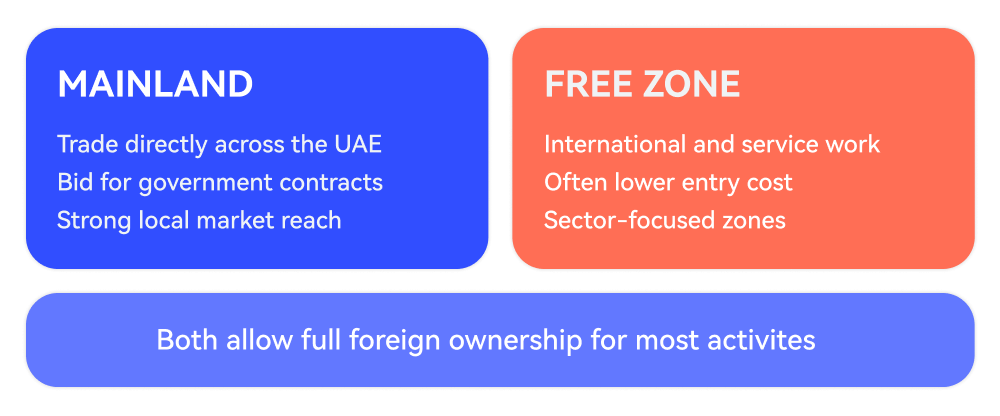
Both routes now allow full foreign ownership for most activities. The difference is reach.
A Mainland setup lets you trade directly across the UAE and bid for government work. A Free Zone authority suits founders serving international or service clients. In 2026, your Dubai Free Zone business setup cost depends on the zone, your visa count, and office needs.
This push to bring in founders sits inside the D33 Agenda, Dubai's plan to double its economy.
Pick a structure that matches your liability and ownership goals. A Limited Liability Company works for most Mainland traders. Free Zone founders usually choose a Free Zone Establishment or a Free Zone Company.
Next, lock in your trade name through the relevant authority. Keep it clean and within UAE naming rules, since the authorities reject anything offensive or misleading.
Your licence is what makes the business legal. You apply through your Free Zone authority or, for Mainland, the Department of Economy and Tourism.
The Dubai Unified Licence (DUL)
The DUL gives your company one national identity across the Emirates. Use this as your quick Dubai Unified Licence (DUL) guide: a single registration number, recognised nationwide, that builds trust with banks and suppliers.
With the licence issued, apply for your investor or employment visa. Then open a corporate bank account, which now asks for your trade licence and clear proof of activity.
For most new UAE companies, FTA Decision No. 3 of 2024 gives you three months from your incorporation or licence date to register for Corporate Tax. The penalty of missing that window is AED 10,000, flat. Confirm the official FTA UAE Corporate Tax registration deadline before you assume you have time.
Do not wait. Set it up through EmaraTax as soon as the licence is issued.
VAT is separate. You register once taxable turnover passes AED 375,000, with voluntary registration available at AED 187,500.
E-invoicing is becoming mandatory in the UAE, run through the Electronic Invoicing System (EIS). It works on Peppol, a global standard. Instead of emailing a PDF, your system sends a structured invoice (the PINT-AE format) straight to your client's system.
Here is the part that takes the pressure off. Companies under AED 50 million in revenue come in from 1 July 2027. Until then, nothing switches on for you.
One detail matters now though. The rules cover sales to businesses and government bodies. Sell only to consumers, and you stay outside the mandate for now, unless the Ministry changes that.
So the move at setup is small. Capture each customer's legal name and tax registration number cleanly from your very first invoice. That one habit turns the eventual switch to structured invoicing into a formality rather than a scramble.
Questions Dubai Entrepreneurs Ask Most
How much does it cost to start a small business in Dubai?
It depends on the activity and legal structure. The Mainland or Free Zone call, plus how many visas you need, moves the number the most.
Is it better to start in a Dubai Free Zone or Mainland?
Both now offer full foreign ownership for most activities. Mainland allows direct trading across the UAE market, while a Free Zone tends to suit international and service-based businesses.
Do entrepreneurs in Dubai need to register for VAT?
You have to register for VAT once your taxable turnover crosses AED 375,000. You may register voluntarily at AED 187,500 if that fits your cash flow and client base.
Will UAE e-invoicing apply to new businesses?
Yes, if you sell to other businesses or to government bodies. Sell only to consumers? You are outside the mandate for now. If you are in scope and on the smaller side, you have until 1 July 2027 to get ready.
What is the easiest way to start a business in the UAE?
Setup agencies and platforms like Invest in Dubai can process your licence quickly. Just do not outsource your compliance liability; your tax and invoicing duties stay with you.
A few years ago, a spreadsheet and one year-end visit covered most small firms. Corporate Tax ended that era. Knowing how to choose an accountant for a small bu...
A laptop, a Wi-Fi connection, and a bit of nerve. That sits closer to the real starting line than any business degree. Many of the best online business ideas in...
No local sponsor is needed. If you want to start a business in UAE as a foreigner, the formation process is faster than most expect. The real challenge is what ...
You do not need a lot of money to start a business in Dubai. The best business ideas in Dubai with low investment in 2026 are all service-based: consulting, dig...
Download the app and make your everyday
life more efficient*
* coming in late 2026