How to Choose an Accountant for Your Small Business in the UAE
A few years ago, a spreadsheet and one year-end visit covered most small firms. Corporate Tax ended that era. Knowing how to choose an accountant for a small bu...
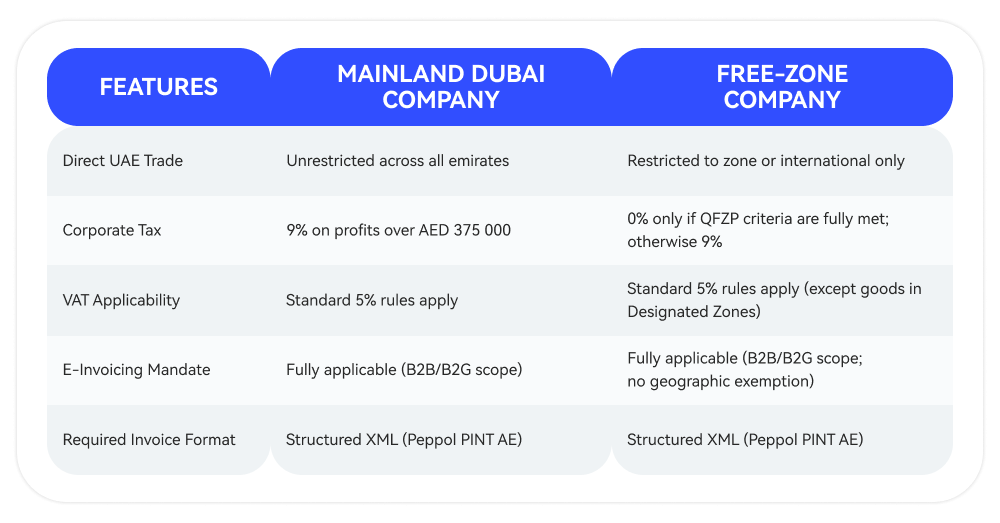
Picking a company structure in Dubai is not a branding exercise. It determines who you can legally sell to and how your corporate tax position works. The free zone vs mainland Dubai split has real operational consequences.
VAT applies to both.
Corporate tax applies to both.
The 2026/2027 e-invoicing mandate treats both the same way.
The Department of Economic Development (DED) in each emirate issues mainland licences. Trading rights cover all seven emirates, government tenders included, with no customer geography restrictions.
Since 2021, foreign founders can own 100% of a mainland company in most sectors. The old Emirati sponsor requirement is largely gone.
The UAE has over 40 designated economic zones, each running under its own regulatory body. A free zone company is incorporated within one of them. Licence types, fee structures, and operating conditions vary across zones.
International trade, digital services and export-heavy businesses are what free zones were designed around. Direct physical sales into the UAE mainland market are restricted. A mainland distributor, commercial agent, or formal branch entity is required to bridge that gap.
Not automatically. This is the most common misread among founders weighing their setup options.
Corporate Tax and the "Qualifying Free Zone Person" Reality
Under Ministerial Decision No. 229 of 2025, a free zone business can access a 0% corporate tax rate, but only by meeting the full statutory criteria for a Qualifying Free Zone Person (QFZP). The conditions are specific. They are not satisfied by incorporation alone.
To hold QFZP status, non-qualifying income must not exceed 5% of total revenue or AED 5 million, whichever is lower. That threshold is narrow. A single domestic mainland contract handled outside the qualifying income framework can breach it.
If QFZP conditions are not satisfied, the standard 9% corporate tax rate applies. Same as a mainland entity.
VAT Registration and Designated Zone Rules
VAT registration is mandatory once taxable supplies exceed AED 375,000. This applies to both mainland and free zone companies without exception.
The material difference for free zone businesses sits in designated zone VAT treatment. Physical goods moved between businesses within officially gazetted designated zones may fall outside the standard 5% VAT framework under specific supply conditions. Services do not receive that exclusion.
Mapping your actual supply chain against designated zone VAT classifications requires precision. A cross-border services business operating from a free zone will almost certainly follow standard VAT rules in full.
No. Under the UAE Electronic Invoicing Guidelines v1.0, published 23 February 2026, a company's jurisdiction, mainland or free zone, does not grant any exemption from the e-invoicing mandate. Applicability is determined by transaction type (B2B and B2G) and revenue thresholds. Incorporation location is irrelevant.
All in-scope entities must transmit invoices in structured XML format using the Peppol PINT AE standard, via a Federal Tax Authority-approved Accredited Service Provider (ASP). Standard PDF invoices will not satisfy the requirement.
Under Ministerial Decision No. 244 of 2025, the UAE e-invoicing rollout phases divide across two business waves and a separate government track.
Wave 1 covers businesses with annual revenue of AED 50 million or above. You must appoint an ASP by 31 July 2026 and go live by 1 January 2027. No extensions are written into the framework.
Wave 2 applies below the AED 50 million threshold. Your ASP must be active by 31 March 2027. Full system go-live follows on 1 July 2027.
Two financial penalties apply under Cabinet Decision No. 106 of 2025:
AED 5,000 monthly if your system is non-compliant or ASP is not registered
AED 100 per invoice for each transaction document not submitted through the required channel
Penalties apply automatically. There is no grace period.
A mainland licence may suit your model if you are:
Selling physical goods directly to UAE consumers or retailers
Needing unrestricted access across all seven emirates without a branch structure
Planning to bid on government tenders without an intermediary entity
Working with a revenue mix makes maintaining QFZP conditions difficult
A free zone structure may fit if:
Revenue is predominantly international or digital in nature
You operate within a single zone or export-facing sector
You can satisfy and hold all QFZP statutory conditions
You have no physical goods distribution requirements into the mainland
FAQs
Can a Free Zone company sell directly to customers in Mainland Dubai?
For services, yes. For physical goods, no. A licensed mainland distributor, commercial agent, or registered mainland branch entity is required.
Are Free Zone companies exempt from UAE e-invoicing laws?
No. Transaction type and revenue thresholds determine applicability under the UAE Electronic Invoicing Guidelines v1.0. Company location does not.
Can a business hold both a Free Zone and a Mainland licence?
Possible, and many do. The two licences run independently. Each has its own authority and cost structure, letting you combine zone-based tax positioning with full mainland trading rights.
Can you convert a Free Zone company to a Mainland entity?
There is no direct conversion path. Most businesses either close the free zone entity and set up a new mainland company. Alternatively, they add a mainland branch while the free zone licence stays active.
A few years ago, a spreadsheet and one year-end visit covered most small firms. Corporate Tax ended that era. Knowing how to choose an accountant for a small bu...
A laptop, a Wi-Fi connection, and a bit of nerve. That sits closer to the real starting line than any business degree. Many of the best online business ideas in...
No local sponsor is needed. If you want to start a business in UAE as a foreigner, the formation process is faster than most expect. The real challenge is what ...
You do not need a lot of money to start a business in Dubai. The best business ideas in Dubai with low investment in 2026 are all service-based: consulting, dig...
Download the app and make your everyday
life more efficient*
* coming in late 2026