How to Choose an Accountant for Your Small Business in the UAE
A few years ago, a spreadsheet and one year-end visit covered most small firms. Corporate Tax ended that era. Knowing how to choose an accountant for a small bu...
Three major market windows fit inside one Dubai working day. Asia closes in the morning. Europe runs through the afternoon. New York comes online before close. That UTC+4 position puts a founder in contact with all of them without unusual hours. The city attracts thousands of new businesses each year for good reason: fast setup timelines, zero personal income tax, and direct access to one of the world's most active trading environments. A successful small business setup in Dubai comes down to taking the right actions in the right order.
What are the steps for small business setup in Dubai?
The process of a small business setup in Dubai can be explained in ten steps, each building on the last.
This is the most important decision you will make in setup. It determines your market access, your license cost, and which customers you can invoice without restriction.
Mainland businesses can trade freely across the UAE, including with government entities. Free zones allow full foreign ownership. They generally have faster approval processes, though trading directly with UAE mainland clients creates complications. Your customer base should drive this decision.
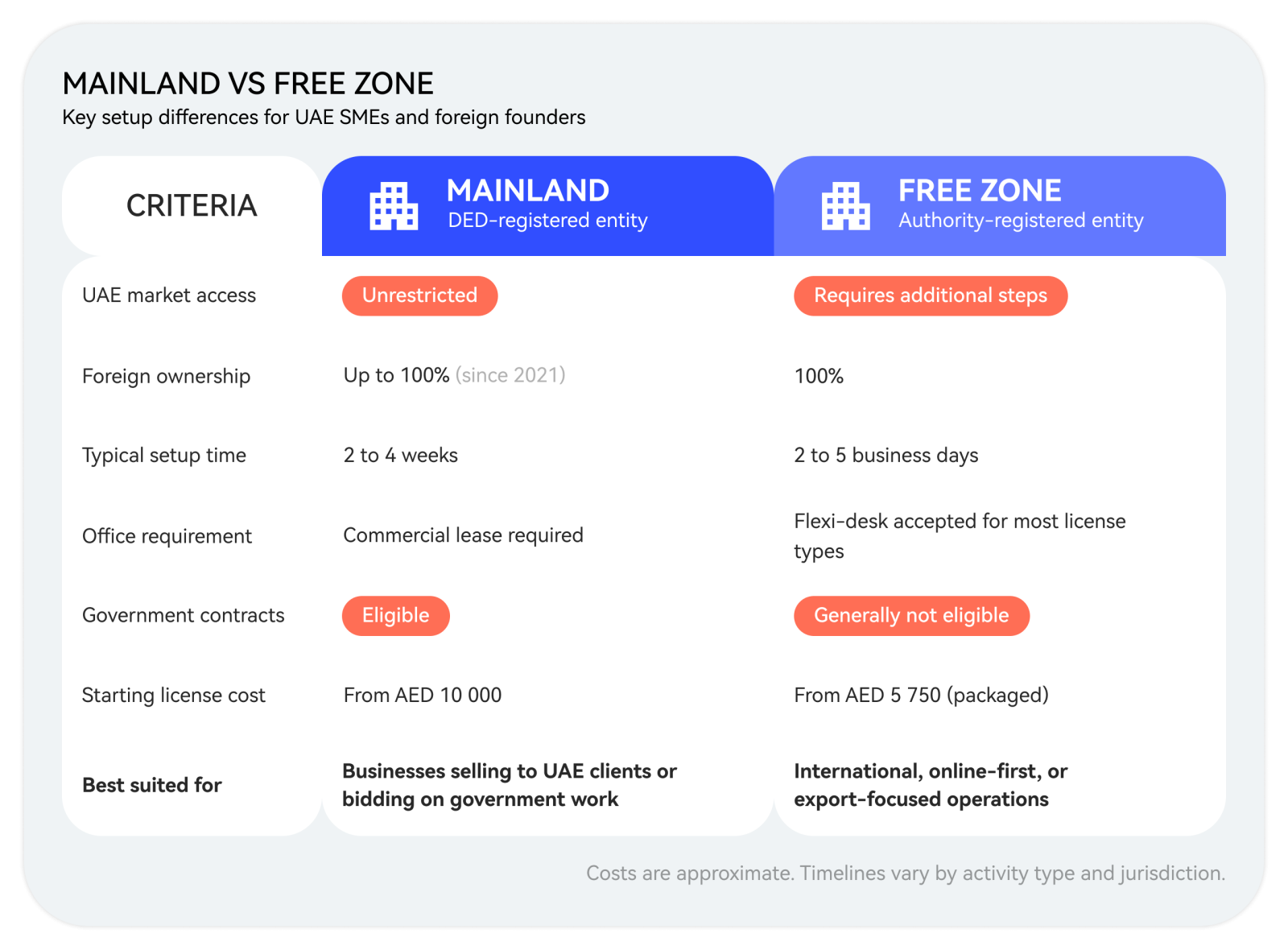
UAE law gives founders several options. Three cover most SME setups:
For most founders coming from outside the UAE, an LLC or FZ-LLC is the more secure starting point.
UAE trade name rules fall under the Commercial Companies Law. Mainland registration goes through the Department of Economic Development (DED). Free zone authorities manage their own name registration independently.
The naming rules are specific:
Name reservations expire. Do not sit on the confirmation.
Initial approval indicates that your activity and ownership structure have cleared the first regulatory check. The final license comes later.
Healthcare, education, and financial services need clearance from a sector regulator on top of the standard process. Before submitting anything, check whether your activity triggers a secondary approval requirement.
Every license type requires a registered address. A flexi-desk qualifies for most. Free zones typically offer their own tiered workspace packages. Mainland businesses must lease registered commercial premises.
Your lease or workspace agreement is a required document in the license application. No address, no license.
An LLC needs a Memorandum of Association (MOA), drafted, signed, and notarised before the license is issued. This document sets out ownership structure, share split, and the role of each partner.
Free zone FZ-LLCs use an equivalent document, typically called an Articles of Association, prepared through the free zone authority. The format varies by jurisdiction.
The trade license is what makes your small business setup in Dubai official. It is the formal permission to operate your listed activity in the UAE. Mainland businesses collect theirs from the DED; free zone companies go through their respective authority.
The license renews every year. Starting costs sit around AED 5,000, shifting up depending on activity type, jurisdiction, and office setup. Treat it as a standing annual expense.
UAE banking is often where founders hit their first real delay. Banks operate under strict AML and KYC requirements, and new companies, particularly those with foreign shareholders, receive close scrutiny. Expect to provide your trade license, MOA, shareholder passports, source of funds documentation, and a detailed description of your expected transactions.
Traditional banks can take anywhere from one week to six weeks to approve a new business account. Digital-first options such as Wio Bank have shortened that window for some business types. Starting applications at two or three institutions at the same time is not unusual and often sensible.
If you plan to live in the UAE, company formation gives you the basis to apply for a residence visa under your own business. The process runs in stages:
The full process typically takes two to four weeks. Each license carries a visa quota, determined by your office space or workspace tier. A flexi-desk typically supports one to three visas. If you plan to hire staff or sponsor dependents, factor visa allocation into your workspace decision early.
VAT registration is completed through the FTA's EmaraTax portal and is mandatory once your taxable turnover meets the registration threshold. Your Tax Registration Number (TRN) must appear on every invoice you issue from the point of registration.
Do not treat this as something to revisit after launch. Add it to your checklist before you start activities.
The mandatory threshold is at AED 375,000 in annual taxable turnover. Voluntary registration opens at AED 187,500. If you expect to reach either figure within 30 days, register immediately.
UAE VAT runs at 5%. Registered businesses collect it from customers and file returns with the FTA on a monthly or quarterly basis. A missing TRN on an issued invoice is not a minor oversight. It is a compliance failure that carries penalty risk.
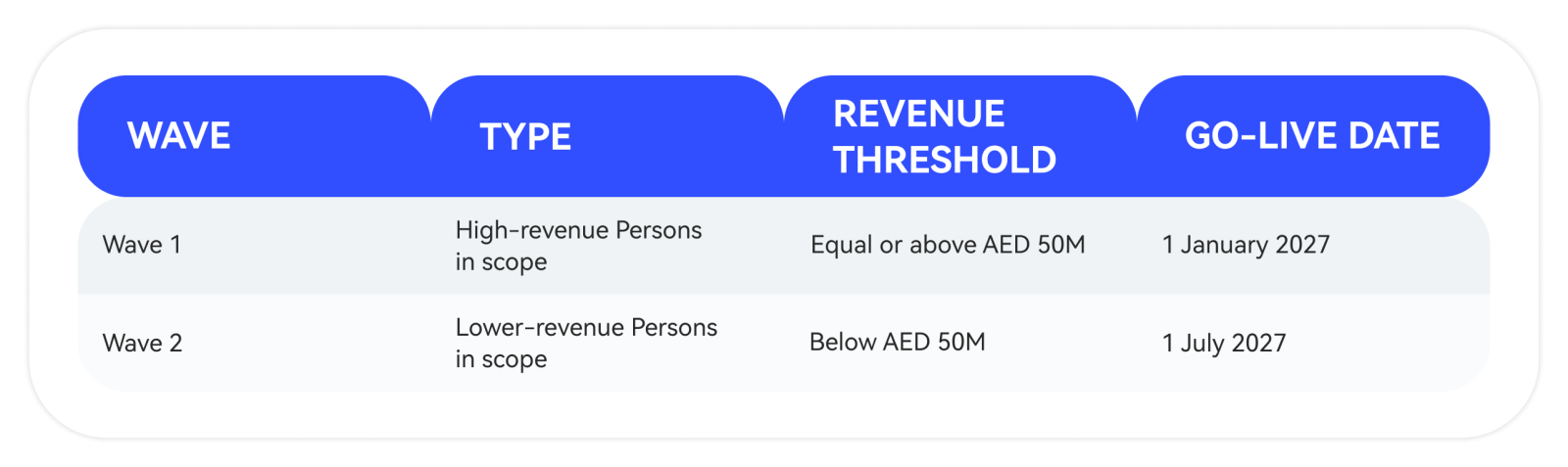
January 2027 marks the start of a phased Electronic Invoicing System (EIS) in the UAE, overseen jointly by the Ministry of Finance (MoF) and the FTA. Implementation is staged by revenue size for Persons and in a separate phase for Government Entities.
No. The 2021 Commercial Companies Law opened full foreign ownership for mainland LLCs across most activity categories. Free zones have allowed it from the start.
Depends on the jurisdiction and activity type. A straightforward free zone application can close in 2 to 3 business days. Mainland licenses covering regulated activities run closer to 2 to 4 weeks.
No. EmaraTax requires an active trade license to complete VAT registration. The license should be secured first.
Trade license, workspace, MOA notarisation if you are forming an LLC, and residency visa fees make up the bulk of it. Many free zones roll those into a single annual package, which at least keeps the billing predictable.
A few years ago, a spreadsheet and one year-end visit covered most small firms. Corporate Tax ended that era. Knowing how to choose an accountant for a small bu...
A laptop, a Wi-Fi connection, and a bit of nerve. That sits closer to the real starting line than any business degree. Many of the best online business ideas in...
No local sponsor is needed. If you want to start a business in UAE as a foreigner, the formation process is faster than most expect. The real challenge is what ...
You do not need a lot of money to start a business in Dubai. The best business ideas in Dubai with low investment in 2026 are all service-based: consulting, dig...
Download the app and make your everyday
life more efficient*
* coming in late 2026